
A New Take on Futurism

In this comprehensive 11-part sermon series review, you’ll discover a new form of premillennialism which utilizes tools such as the biblical calendar, Hebrew idioms, ancient near-eastern history, and comparative mythology to “unlock” prophetic codes that often seem like a foreign movie without subtitles to modern readers.

The material explores the dramatic climax of human history through the lens of biblical typology and geopolitical prophecy. It draws parallels between ancient events in Genesis—such as Noah’s Flood and the Tower of Babel—and the final unified systems of the end times, identifying the “Revived Roman Empire” (Kittim) as the primary global superpower. Central to this narrative is the distinction between human tribulations and divine wrath, the identification of the Antichrist as an ancient entity returning from the “Abyss,” and the literal fulfillment of the Fall Feasts during the Second Coming of Yeshua.
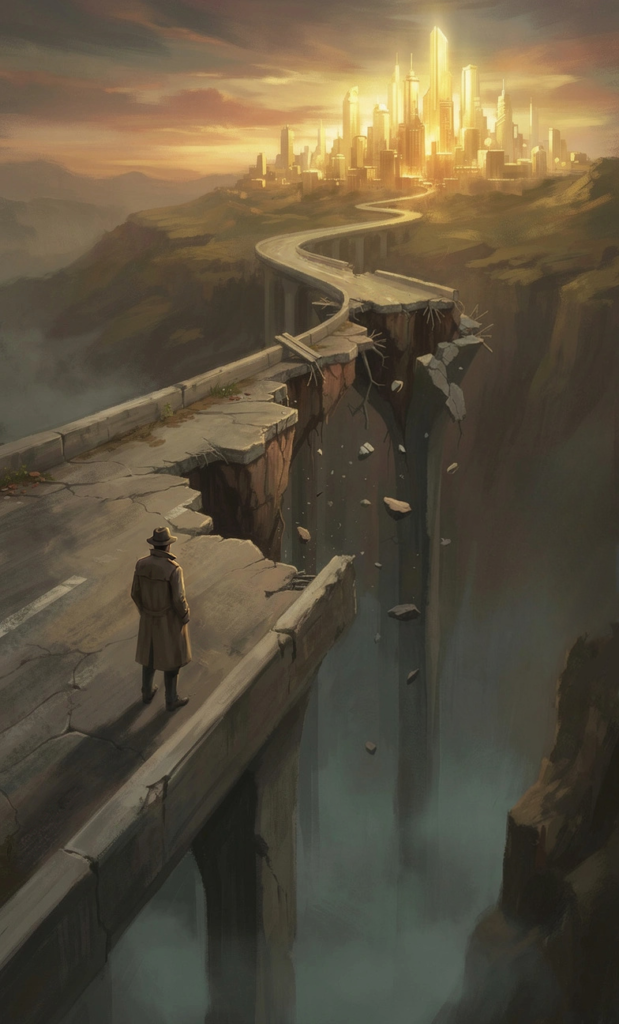
A broken road to Zion

Session One Intro

If you take the same interpretive approach to end-times prophecy as you do to any other part of Scripture, you’ll end up a premillennialist. Even its opponents acknowledge that. That doesn’t mean, however, that Futurism as it’s been taught thus far is without fault.

This outline introduces a new form of Futurism called “Qedem Premillennialism.” It details the theological critiques of existing views and the foundational principles of this alternative perspective.

  • The Major Categories: Traditional views include Amillennialism, Post-millennialism, Preterism, Dispensational Premillennialism, and Historic Premillennialism.
  • A New Approach: Introduction of “Qedem Premillennialism,” a view that shares similarities with existing types but addresses minor, significant differences.
  • The Meaning of Qedem: A Hebrew word meaning “ancient,” “east,” or “origin,” suggesting a return to the original understanding of the end times, predating Greek or Roman theology.

Critiques of Existing Views

A. PROBLEMS WITH HISTORIC PREMILLENNIALISM
  • Misunderstanding Israel: It ignores the election of Israel and the unconditional promises made to the nation.
  • Replacement Theology: It erroneously applies “the church” over Israel, a concept the Bible never explicitly authorizes.
  • The Nature of the “Church”: The term is a translation of ecclesia (Greek) or kahal (Hebrew), meaning the “assembly” or “congregation of the Lord,” which has existed since the days of the patriarchs.
  • Neglect of the Holy Calendar: It fails to acknowledge God’s biblical calendar and its prophetic intervals, which are essential for understanding imagery in books like Revelation.


In other words, the problem with Historic Premillennialism is that it discards the roots of our Faith as dead and irrelevant. It operates within a Romanized form of Christianity which is sadly divorced from the original Hebrew character of the Kingdom and the everlasting Jewish identity of the King.  

The “Hebrew Movie” Analogy: Reading end-times prophecy from this perspective is like watching a foreign movie without subtitles; the “code” can only be  unlocked through Hebrew numerology, the Hebrew calendar, Hebrew customs, Hebrew idioms, and an understanding of the covenants God made with certain righteous Hebrew men.

B. PROBLEMS WITH DISPENSATIONAL PREMILLENNIALISM
  • Artificial Divisions: It divides history into distinct segments rather than recognizing a series of cumulative covenants.
  • Mislabeling the Seven Years: It interprets the Great Tribulation as seven years, whereas Yeshua described it as a three-and-a-half-year period following the “abomination of desolation”.
  • The Scope of Law: It claims believers under the “dispensation of grace” do not need to follow the laws given through Moses—a view which is inconsistent with God’s unchanging moral character.
  • Conflating Wrath and Tribulation: It treats God’s wrath as synonymous with human/Satanic tribulation. It does so to support a Pre-tribulation Rapture theory which also doesn’t stand up to scrutiny.

Foundations of the Doctrine

A. THE IDENTITY OF ISRAEL
  • Elect Nation: Israel was chosen by God as a “treasured possession” (Deuteronomy 7:6; Isaiah 45:4; Psalm 135:4).
  • Grafted In: Gentiles who believe are not a “new” group but are “grafted into” the 12 tribes and the Commonwealth of Israel through faith. As per Paul’s analogy in the Book of Romans, the “olive tree” of Israel remains the same even if natural branches are broken off.
  • One New Man: There is no distinction between Jew and Gentile in Christ; both are part of one nation with a single “constitution” (God’s word, God’s laws, and God’s method of extending mercy to violators).
  • Irrevocable Calling: God’s promises to the ethnic descendants of Jacob remain valid, and a remnant will eventually recognize Yeshua and be saved (Romans 11:26).
B. DISTINGUISHING WRATH FROM TRIBULATION
  • God’s Wrath: A righteous judgment against unrepentant sin and rebellion intended to destroy or eliminate evil (Romans 1:18). Believers are explicitly promised deliverance from this wrath (1 Thessalonians 1:10, 5:9).
  • Tribulations: Pressures, afflictions, and persecutions faced by believers in a fallen world. These are intended for sanctification, refining character, and testing the genuineness of faith (Romans 5:3-4; 1 Peter 1:6-7).
C. THE DIVINE DELAY
  • A Legal Battle: The delay in Christ’s return is part of a “legal battle” where the enemy and the fallen “gods over the nations” are given 6,000 years to rule and plead their case.
    • The full 7,000 years, which includes the Messianic millennium as the 7th “day,” are variously called “The Septeon” and “The Great Week”
  • Refinement of the Bride: The “fire” of history must reach a peak to fully purify the Bride (the assembly) before the groom returns.

The End Matters

Everyone loves a good story. God is telling one of those. Every good story leads to a climax and a satisfying resolution. As we’re reading or watching the story unfold, we wonder how it’s going to end. We yearn for it to end well, and not be a let-down. The end matters very much, which is obvious because you don’t stop reading a great book a few chapters before the final page, or turn off a movie in the middle of the third act.

END-TIMES TYPOLOGY IN GENESIS

God has been telling the end from the beginning. There are several “types” or shadows of the end times found in the first book of the Bible:

  • Proto-Evangelium (Gen 3:15): The first promise of the Savior crushing the serpent’s head.
  • Noah’s Flood: A type of global judgment and wrath that cleanses the earth from evil; the Ark represents Yeshua, and Noah’s family represents the righteous remnant.
  • Sodom and Gomorrah: A foreshadow of final judgment by fire and the rescue of God’s people from wrath.
  • Tower of Babel: Represents the final, unified humanistic system (“Mystery Babylon”) that defies the Creator.


The end of a story always matters and is, in fact, indispensable. The only truly climactic, satisfying, and emotionally gripping ending to the story of the Bible is the one presented by premillennialism.

Session Two Intro

Before getting into a full survey of Qedem Premillennialism, let’s establish a clear understanding of the basic arguments for premillennialism in general (all flavors).

Premillenialist Reasoning

A. IMPORTANT PROPHECIES AWAITING FULFILLMENT

Many prophecies have not yet, even two thousand years since Christ’s resurrection, fully come to pass. They hadn’t come to pass during the first century, either, according to early Christians such as Tertullian, who wrote:

Jesus was questioned by his disciples concerning when those things were to come to pass.… Then, he spoke about the things that will concern all nations—up to the very end of the world…. Therefore, although there is presently a sprouting in the acknowledgement of all this mystery, yet it is only in the actual presence of the Lord that the flower will be developed and the fruit will be borne…. Who has yet beheld Jesus descending from heaven in a manner similar to how the apostles saw him ascend?…. Up to the present moment, no one has smitten their breasts, tribe by tribe, looking on him whom they pierced. No one has yet fallen in with Elijah. No one has yet escaped from the Antichrist. No one has yet had to bewail the downfall of Babylon. (Tertullian, c. 210)

We’re still waiting for the things he listed (and more)  to manifest, which means that Preterism is not a valid option.

Many of the prophecies awaiting fulfillment have to do with the reversal of the Diaspora. Here’s a sampling of prophecies which describe for us what that will look like: Isaiah 11:1-16; Isaiah 60:1-14; Jeremiah 16:12-15; Amos 9:11-15; Psalm 2:8-9; Rev. 2:26-27; Rev. 12:5; Rev. 19:15.

Amillennialism can’t address these passages except to claim that they are all some kind of complex, detailed metaphor. (But why? Who knows?) Postmillennialism also can’t handle these passages because if all the nations of the earth are to become Christianized before Christ’s return, then why are Christ and his saints having to rule the nations with iron rods?

B. A LITERAL 1,000-YEAR MESSIANIC “DAY”
  • The 7,000-Year Plan: The timeline of history (“the Septeon”) mirrors the Menorah: four millenniums leading to the first coming of Messiah, followed by two “in-between” millenniums, concluding with a 1,000-year Messianic Age.
  • Early Historical Support: Several early “church fathers” taught that the world would be completed or remodeled at the 6,000th year, followed by a 1,000-year rest or kingdom. For example:
    • Komodianus (c. 240 AD): Stated Christ’s return and the rising of the dead occur after 6,000 years.
    • Barnabas (70–130 AD): Taught all things would be completed in 6,000 years.
    • Irenaeus (c. 180 AD): Argued the world would conclude at the 6,000th year, following the six-day creation pattern.
    • Hippolytus (205 AD): Noted 6,000 years must be fulfilled to reach the “Sabbath” of the future kingdom.


Scripture contains many typological and numerological examples of the Septeon  (see Elder Alexander for a full list if interested)

C. THE REALITY OF THE TWO RESURRECTIONS
    • Literally “Living” (Revelation 20): The text describes two bodily resurrections separated by 1,000 years.
    • Greek Analysis: The Greek words for the martyrs “living” (zaō) and the rest of the dead “coming to life” (anazaō) are identical in form, suggesting both must be interpreted as the same physical change of state.
    • The Living Soul: Biblical theology (Genesis) defines a “living soul” as an animated body with the breath of God; therefore, a soul “brought to life” must involve a body.

Session Three Intro

From here, let’s walk backwards in time from the Messianic Age to the Abomination of Desolation, skipping over the defeat of the Beast’s armies, the Fall of Babylon, the final diaspora & enslavement of the Jewish people, and a couple of other things.

By understanding the Abomination of Desolation, we can begin to build a timeline of pivotal events in the Last Days.

Note that Yeshua said “Let he who hears understand.” In other words, you’re going to have to study this to gain understanding. It’s not easily grasped. Apply yourself and rightly divide the text.

This session focused primarily on the interpretation of Daniel’s 70 Weeks, the identity of the “Coming Prince” who sets up the Abomination, and the symbolic history of world empires.
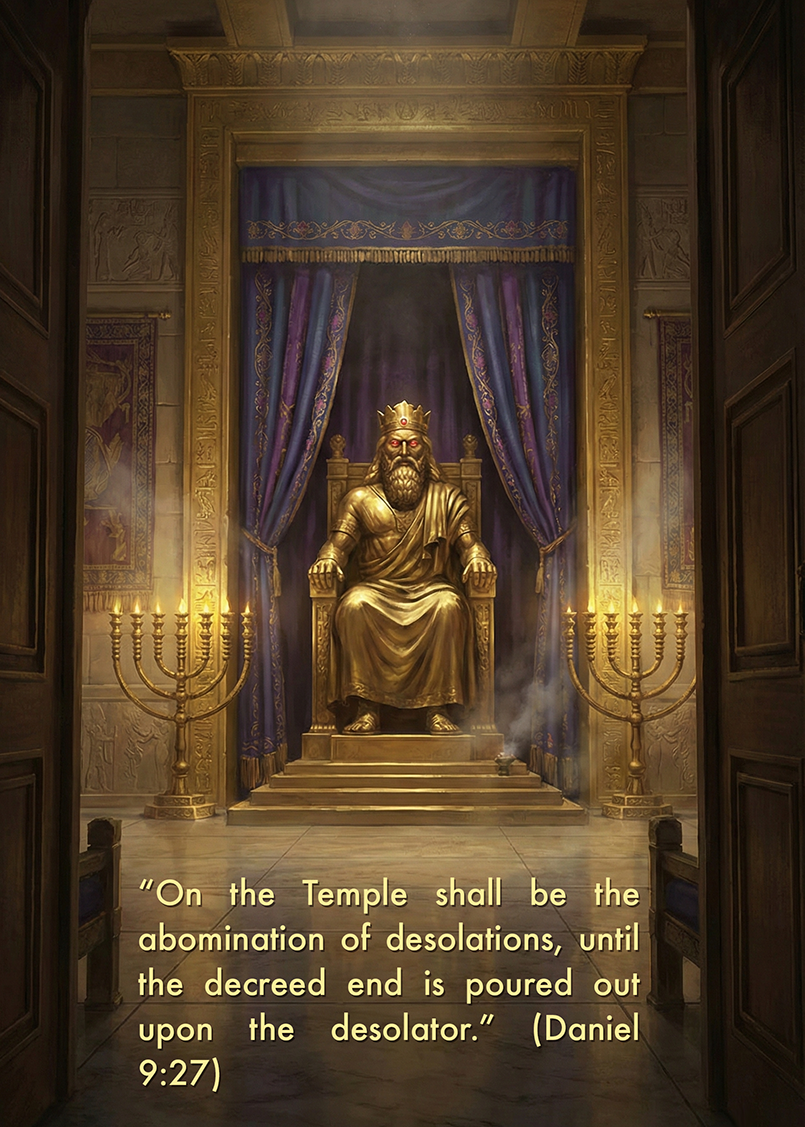
Prophecy of the 70 Weeks

A. THE TIMELINE GIVEN BY GABRIEL IN DANIEL 9:24-27
  • The Nature of the “Weeks”: The Hebrew term refers to “sevens”. In this prophetic context, these represent 70 cycles of seven years (490 years total).
  • The Starting Point: The prophecy begins with the decree to restore and rebuild Jerusalem. While four relevant decrees exist in Scripture, the fourth—Artaxerxes to Nehemiah to rebuild the city and walls—is likely the correct starting point.
  • Historical Fulfillment:
    • The First 49 Years: Ended in 408 BC with the completion of the city wall during “troubled times”.
    • The Next 434 Years: Spans the period until the arrival of the Messiah.
    • The Anointed One is Cut Off: Some translations have “not for himself,” while others have “the city and the holy place are not his.” Either way, this is a very unexpected end for a Messiah who was expected to take over the world for Israel.
      • Narratively, once Messiah is “cut off,” his role in the vision is finished. If he is gone, he cannot continue as the subject of the following verbs. To argue otherwise makes him both the one cut off and the one acting.
  • The Program is Paused:
    • There is a gap in the “sevens” upon Messiah’s arrival, almost as if the prophetic clock pauses, because the text skips years forward to the time of his removal, then skips forward again forty years to the destruction of Jerusalem and the Second Temple by a flood of Roman soldiers.
      • Depending on how you want to interpret this, it could even be talking about a lengthy time stretching until the end of the Age, during which Jerusalem and the Temple Mount would always be in some form of conflict, and repeatedly desolated. Either way, the progression of the 70 weeks has stopped.
    • The prophecy of Judah’s 70 weeks has paused because the House of Judah rejected their King. The prophetic clock will start ticking again when the false Messiah shows up and is accepted by the Jews.
    • The current age is a hiatus where the focus has shifted to gathering the scattered tribes of Israel and elect Gentiles.
      • Yeshua noted in Matthew 15:24 (cf. Matt. 10:6) that he was sent only for the lost sheep of the House of Israel (the ten northern tribes who were scattered amongst the Gentiles). He has used the faithful remnant of the Jews to accomplish that task, but the tribe of Judah as a whole has been estranged during the 5th and 6th millenniums.
B. THE TWO PRINCES
  • Identity of the “He” (Daniel 9:27): Early Christian and Jewish history unanimously viewed the mysterious “he” who confirms a covenant as a hostile figure (the false Anointed One, in contrast to the real but cut off Anointed One). 
    • Calvin and later Reformers argued it was Christ, but this creates significant grammatical and theological contradictions.
      • If “the prince of the people who are to come” were Yeshua, then “the people” would be His followers. These, the angel Gabriel told Daniel, will “destroy the city and the sanctuary.” Yet the ones who destroyed Jerusalem and the Temple in AD 70 were Roman legions under Titus, not Christians.
      • Furthermore, the Gospels and the Book of Acts provide us with no clearly expressed seven-year covenant or treaty. Nor did Yeshua stop the daily sacrifices at the Temple at the mid-point of a 7-year agreement (even after his crucifixion, the dailies continued for forty years, until the destruction of the Temple).
  • The Character of the Prince to Come:
    • His followers destroy the city and the Temple.
    • He confirms a covenant with many for a final “seven” (one week/seven years).
    • In the middle of the “seven” (3.5 years), he puts an end to “[Yahweh’s] sacrifice and drink offering” (LXX).
    • He desolates the Temple with an abomination.
  • Dual/Triple Fulfillment: History rhymes. The “people of the prince to come” refers to two foreshadows: first, the Greek armies led by King Antiochus IV Epiphanes in 167 BC; then, the Roman legions who destroyed Jerusalem in AD 70 under Titus. These prevenient fulfillments point to the future final fulfillment by Antichrist’s army.
  • Error of the Opposing View: Some believers claim that the entire prophecy recorded in Daniel 9 was fulfilled in AD 70. The main reason that cannot be true is that Gabriel specified what the 70 weeks are meant to accomplish (Dan. 9:24). Have the Jewish people had their final Day of Atonement and their iniquity dealt with permanently so that they are overtaken by everlasting righteousness? No; that can’t happen until they receive Yeshua. Also, vision and prophecy are not finished, because Peter reminded everyone at Pentecost that God would pour out dreams and visions and prophecies upon his servants in the last days. Therefore, this prophecy of the 70 week still awaits completion.

Nebuchadnezzar's Statue (Dan. 2)

A. A HISTORY OF WORLD EMPIRES

Daniel interprets the King’s dream of a massive statue, representing the sequence of secular human empires that oppose God. The parts are to be read chronologically, starting from the head and ending at the ground, where the stone (representing Yeshua) strikes the statue after descending from the heavens.

The legs of the statue represent the eastern and western divisions of the Roman Empire. An interesting thing about legs is that they dwindle to ankles, which are thin and lack muscle, yet are still part of the legs. By this we understand that the empire didn’t come to an end; it just changed shape.

B. ROME NEVER DIED

The Roman Empire was not suddenly destroyed; rather, it gradually ebbed away over centuries. Even then, when its political power was spent and its borders fragmented, it morphed into a new form of authority: the Roman Catholic Church and the Greek Orthodox Church. These are empires without borders, and they continue to have many subjects today.

Modern Inheritances: Our current world is still functionally “Roman” in many sectors. For example:
  • Government: Republic models, senates, and the concept of the veto
  • Law: Civil law system
    • Trial by jury
    • The concept of a contract
    • The idea of being “innocent until proven guilty”
    • Wills and testaments
    • Corporate personhood (the idea that a corporation is a legal entity)
  • Infrastructure: Concrete, arches, domes, columns, plumbing, and modern road networks
  • Academics: The university system, philosophy, advanced mathematics, theater, and epic poetry
  • Language:
    • Latin: The language of Rome is the parent of the Romance languages (Spanish, French, Italian, Portuguese, Romanian). It also provides the root for over 60% of English words, especially in law, medicine, and science (e.g., veto, alibi, bona fide, homo sapiens)
    • Greek: We get thousands of technical, scientific, and cultural words from Greek (e.g., democracy, philosophy, biology, geography, theater)
  • Culture: The Gregorian calendar, names of months and days, the Olympic games, and the medical Hippocratic oath
  • Symbology: Corporate logos (Nike, Amazon, Venus, Oracle, etc.) and NASA programs (Apollo, Artemis, Mercury, etc.) continue to use Greco-Roman mythological names
C. THE “BABYLONIAN PACKAGE” AND THE FINAL END
  • The Roots of Rebellion: All enemy empires trace back to Babel, where occult “mysteries” and prideful world systems began.
  • The Move of Power: This “package” of occult power and empire-building moved from Mesopotamia to Crete and the Levant, then to Egypt, then to Greece and Rome (the writings of Greek philosophers and historians confirm that transference).
  • The Final Resolution: The “Stone” (Yeshua) cut without human hands will eventually strike the statue at its support point—the feet—causing the entire secular human system to collapse and be replaced by God’s eternal kingdom.
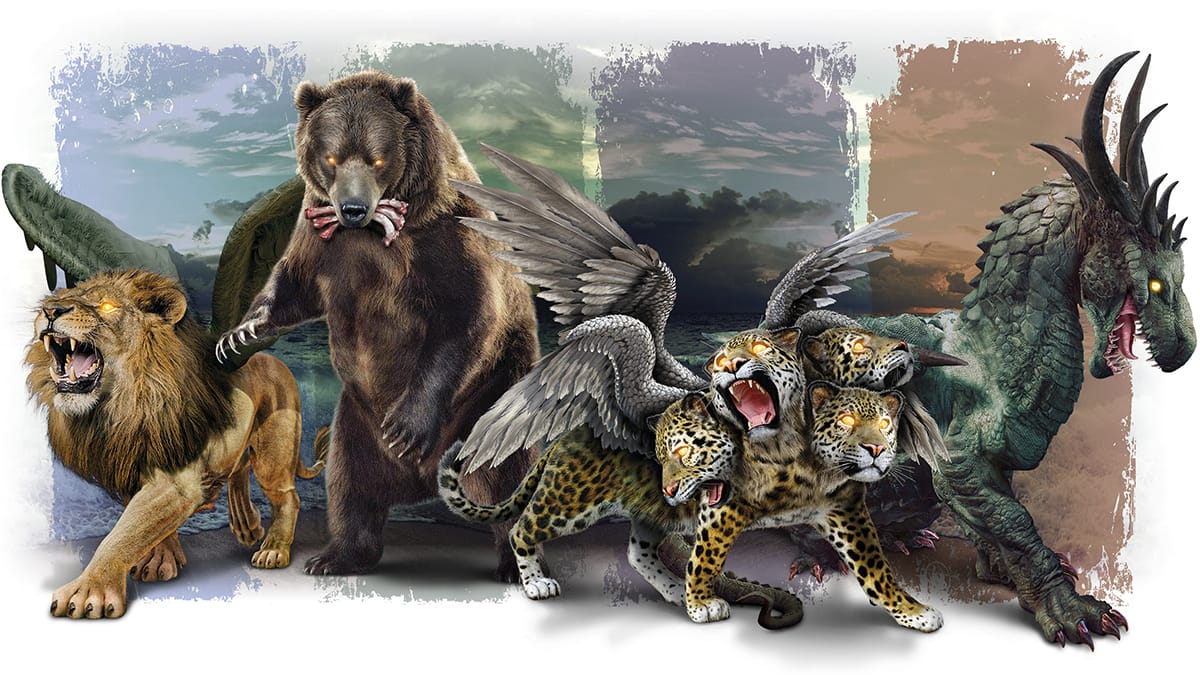
Four unusual beasts representing global empires

Session Four Intro

In the previous session, we discovered that Rome never fully died, and that it will experience reconstitution. As we’ll see from Daniel chapter 7, that will take place just before or during World War III.
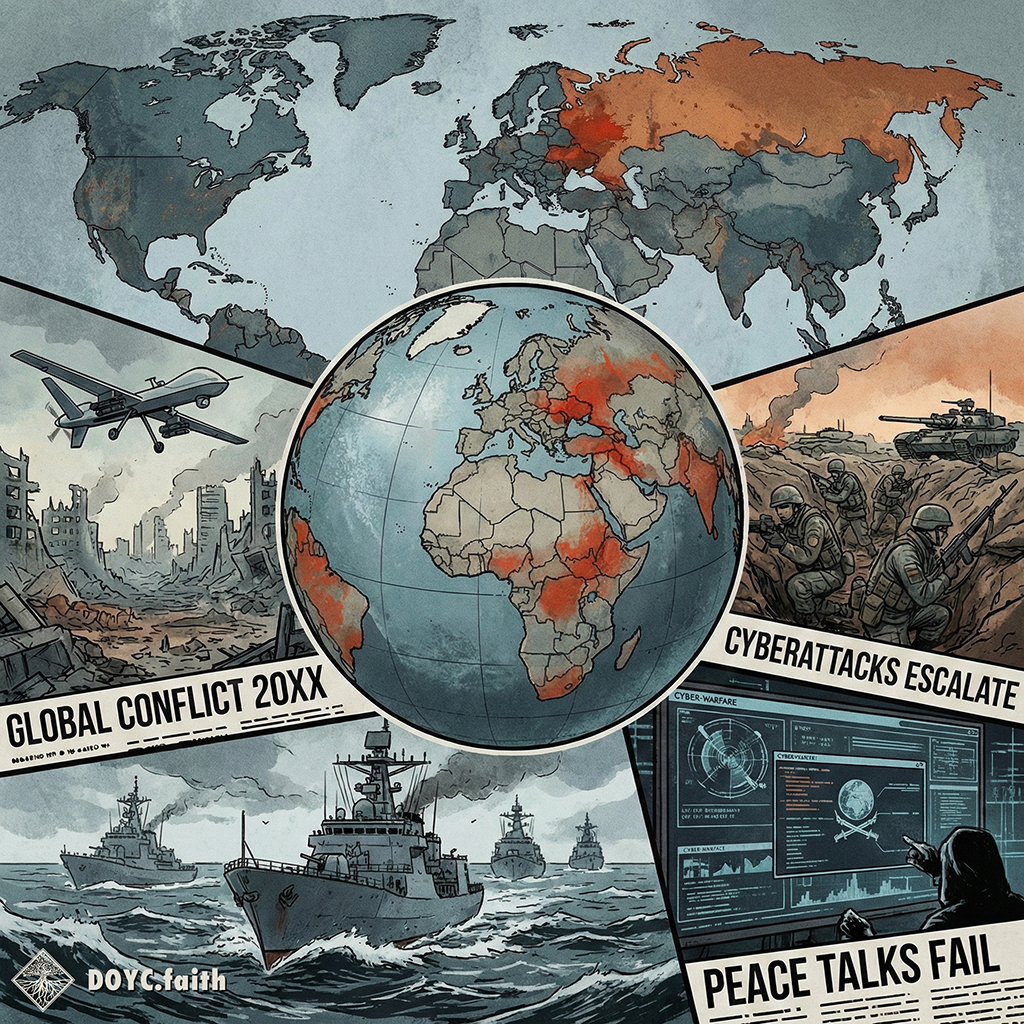
The Global Conflict of Dan. 7

A. THE FOUR BEASTS OF THE END TIMES

Daniel had a dream about four beasts striving upon the Great Sea. We aren’t told what they’re striving against, so they’re probably fighting each other (in other words, this is World War). These beasts are positioned on the Great Sea.

Despite traditional views on this subject, these four beasts are actually contemporaneous, not sequential. They represent global superpowers existing simultaneously at the end of the age because they are judged together and allowed to continue (sans authority) into the Messianic Age (Dan. 7:12).

  • Waters in prophecy stand for the multitudes—specifically, Gentile peoples (Rev. 17:15).
    • This is because Gentiles have no spiritual stability. Their gods and myths change often, and how they relate to the gods shifts. Moreover, they have no unchanging law, no cosmic standard of morality.
    • In contrast, true/faithful Israel is metaphorically like the dry ground. Land is stable. Land does not move like waves do, which is why you can build upon it.
    • The sea is constantly moving and changing, and unsuitable for permanent structures.
    • The Great Sea is an idiom for the Mediterranean.
      • The Mediterranean Sea and its coastlands will comprise the primary zone of  conflict for the four superpowers.

The fact that the lion’s wings are plucked off means that the United States will be removed from superpower status.

After the U.S.A. is removed from the picture, the U.K. will experience a great awakening and turn to the Lord. She will no longer be a beast, because much of the nation and her leadership will become born-again Christians.

Russia, the bear, is already holding three ribs in its mouth prior to receiving the command to devour much flesh. This implies that she will take a bite out of the side of another beast kingdom some time before going on a rampage with WMDs. Considering current geopolitics, this will almost certainly be three nations on the eastern side of the European Union. The bear is also lifted up on one side. This is due to the imbalance of population density in Russia. (Elder Alexander received a word from the Lord about this, explaining that the vast majority of the population is clustered on the western side of the country.)

The leopard kingdom is a collection of nations that have not yet made an alliance. Be on the lookout for a powerful coalition of Asian countries east of the Tigris. Africa has leopards, but there is little chance of a powerhouse empire arising from Africa within the next few decades, so we should place our bets on Asia.

The ten horns of the dreadful (4th) beast must correspond to the ten toes on Nebuchadnezzar’s statue, because both the 4th beast and the feet of the statue represent the final secular superpowers of this Age.

B. THE ELEVENTH HORN (THE ANTICHRIST)

The dreadful, fourth beast seen by Daniel has ten horns representing ten separate kings (likely from ten unified nation-states) who will work together to run the empire. However, there is one more horn who arises after the ten horns are already in place.

  • Arrogance: An eleventh horn rises, displaces three others, and speaks boastfully against God.
    • This 11th king, after taking down three of Rome’s ten horns, becomes the 8th horn.
  • Changing Times and Laws: He attempts to change God’s appointed times (holy days/biblical calendar) and laws.
  • The Duration: The saints are given into his hand for “a time, times, and half a time” (3.5 biblical years).
    • This will most likely follow the installment of the Abomination of Desolation
  • Physicality:
    • He’s stout (physically large).
    • He’s a man of fierce countenance (he has strong facial features and an imposing demeanor).
  • The Destruction: When the Ancient of Days sits in judgment with His divine council, the boastful horn (a.k.a. the Antichrist) is slain and cast into the fire.

Session Five Intro

This session focuses on identifying the end-times role of Rome through the scriptural term Kittim, and exploring the animal symbolism found in ancient prophetic visions.

The Chimera Kingdom

Revelation 13 presents a single beast rising from the sea, but this one beast is a chimera—a combination of the lion, bear, and leopard kingdoms from Daniel 7.
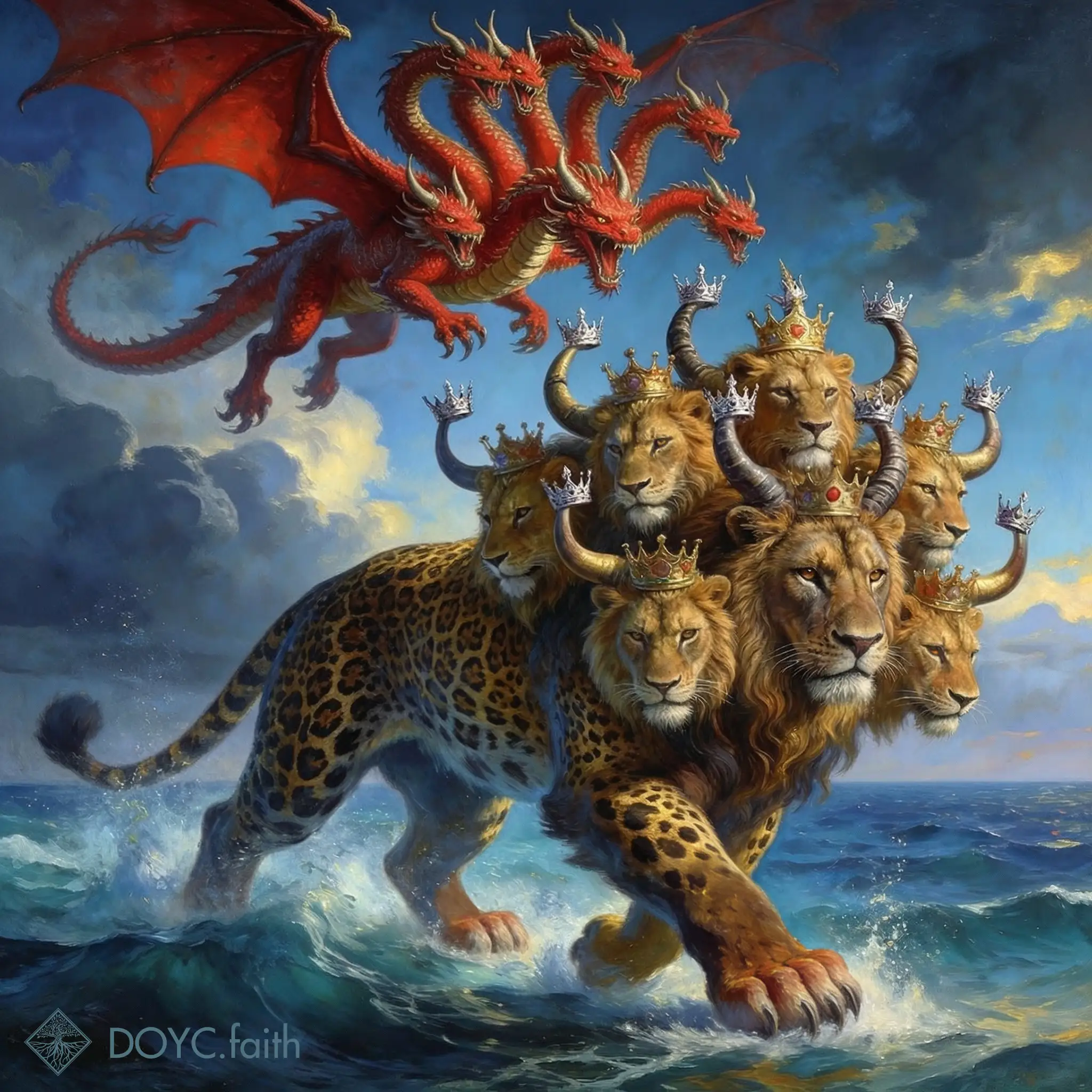
Beyond the fact that it incorporates parts of the Daniel 7 beasts, the chimeric beast of Rev. 13 has four important characteristics:

  • Ten horns:  This symbolic beast has the same number of horns as the fourth, terrible beast of Daniel 7—an amount equal to the toes of the Daniel 2 statue. These are the ten kings of the final Beast Kingdom of the Antichrist, and that fact is explicitly stated in Revelation 17:12-14.
  • Seven heads: The beast from the sea has seven blasphemous heads, which are, according to Revelation 17:9-10, seven kings (likely important kings who ruled throughout the history of powerful empires).
    • Blasphemy = Each king spoke proud things against God and his faithful ones. (Each head also represents a mountain—real or artificial—from which that king received pagan spiritual power.)
  • Sea vs. Abyss: The “Sea” represents the masses of Gentile peoples, whereas the “Abyss” refers to the literal underworld (She’ol/Hades), where the souls of the dead and the spirits of certain evil entities are kept.
    • NOTE that the chimeric beast kingdom arises from the sea, but the Beast (king) himself arises from the Abyss. These are different origins, yet the kingdom and the king are treated as synonymous. The solution to this mystery is provided in a future session.
  • The Antichrist Spirit: This final kingdom is empowered by the “Dragon” (Satan), the chief of principalities, who acts through a human ruler.
A. THE PRINCIPALITIES/KOSMOKRATERS OVER GENTILE NATIONS

It is helpful to keep in mind that, since Babel fell, there have been 70 spiritual principalities ruling over the 70 Gentile people-groups.

  • The Division of Tongues: As a result of the rebellion that occurred at Babel, God handed humanity over to rebellious divine princes called b’nai Elohiym (“the sons of God”—Job 1:6, 2:1, 38:7; Psalm 82:6; Deuteronomy 32:8 ESV or LXX; Genesis 6:2, 6:4).
    • The number seventy comes from the total number of nations listed in Genesis 10, which were scattered throughout the earth after the fall of Babel. It also corresponds to the number of sons of El in Canaanite mythology, and perhaps to the number of divine rulers in Rev. 12:3.
  • The Prince of Persia: In Daniel 10:13, an archangel is blocked by the “Prince of Persia” for 21 days, demonstrating that powerful spiritual beings rule over geopolitical entities.


Given this paradigm, there would have to be a Principality/Kosmokrater behind each of the seven heads of the terrible beast kingdom. Except…

It is perhaps better to imagine that these seven kings were not ruled by the properly assigned Kosmokrater who normally had control. Instead, perhaps Satan himself took charge in these instances. In that case, these kings were the seven world-ruling emperors that Satan personally possessed, and each of them were proudly antagonistic towards Yahweh. Each king hated God’s chosen people and tried to destroy them.

(The identities of these seven kings is partially open to debate, but Sennacherib of Assyria, Antiochus IV Epiphanes of Greece, and Nero of Rome would be a few strong contenders.)

B. ANOTHER TITLE FOR THE END-TIMES ENEMY

In biblical prophecy, the Sons of Kittim represent the archetype of the “Other” from across the sea. They are the people of the ships, the people of the islands, and ultimately, the iron-shod legions of Rome that would change the course of Jewish history.

  • The Concept of Kittim: Kittim (pronounced “kit-eem”) was used as the prophetic name for Rome before the word Rome existed. It originates in Genesis 10:4 as the name of the son of Javan (one of the grandsons of Japheth, son of Noah).
    • Javan was the progenitor of the Greeks
  • Biblical References: The term appears in Daniel 11:30, where “ships of Kittim” oppose the willful king, and in 1 Chronicles.
C. FROM CYPRUS TO THE WESTERN MARITIME POWERS
  • Geographic Root: Through the endeavor of human migration studies, we can determine that the sons of Kittim became inhabitants of Kition (modern-day Larnaca) on the island of Cyprus.
    • Flavius Josephus (1st Centruy AD): Josephus provides the clearest and most influential identification in his Antiquities of the Jews. He explains how the name evolved from a person to a place:

“Cethimus [Kittim] possessed the island Cethima: it is now called Cyprus; and from that it is that all islands, and the greatest part of the sea-coasts, are named Cethim by the Hebrews: and one city there is in Cyprus that has been able to preserve its denomination; it has been called Citius [Citium/Kition] by those who use the language of the Greeks.” — Antiquities 1.128

  • St. Jerome (4th Century AD): Jerome, drawing on both Jewish tradition and Greek scholarship, reinforced this in his commentaries and letters:

“Kittim: from whom come the Cypriots and the Rhodians… from whose name the city of Citium in Cyprus was also called.” — Hebraicae Quaestiones in Genesim (Commentary on Genesis)

  • The Prophet Isaiah: In Isaiah’s writings, the relationship between the Phoenician mainland (Tyre/Sidon) and the Kittim is one of immediate maritime proximity because Cyprus is the first “port of call” when fleeing the mainland:

“Wail, O ships of Tarshish, for Tyre is laid waste… from the land of Kittim it is revealed to them… Pass over to Kittim; even there you will have no rest.” — Isaiah 23:1, 12

  • The Shift: Over time, the term expanded through a process of synecdoche, where a part represents the whole. By the time of the prophets (Isaiah 23:1, Jeremiah 2:10), “Kittim” referred generally to the islands of the Mediterranean and the coastlands of the West.
    • Stage 1 – The City of Kition (Citium): The migration began at the city of Kition (modern-day Larnaca) on the southeast coast of Cyprus. This was the principal point of contact between the Phoenicians and the Japhetic/Indo-European world (the “Sons of Javan”). Because Kition was the gateway through which Westerners entered the Levant, the people there were the first “Kittim.”
    • Stage 2 – The Island of Cyprus: As trade increased, the name of the city (Kition) was applied to the entire island. In the Royal Assyrian inscriptions of the 8th century BC (such as those of Sargon II), Cyprus is referred to as the land of the Iadnana (Ionians), but the local Phoenicians and Hebrews continued to use the term Kittim to describe the island.
    • Stage 3 – The “Western Coastlands”: By the time of the late prophets and the Dead Sea Scrolls, the term had “migrated” again—this time across the sea.
      • When Alexander the Great (a Macedonian) conquered the East, he was seen as a “Son of Kittim” because he arrived from the same western maritime horizon (1 Maccabees 1:1).
      • Perseus of Macedon is called King of the Kittim in 1 Maccabees 8:5.
          • At its height, the Macedonian Kingdom owned most of the islands and coastlands north of Cyprus, and most of inlands Greece as well.
          • Macedon was absorbed as a Roman province during the late second century BC.
    • When the Roman legions arrived in the Levant in force, their superior naval power and “ships of Kittim” (Daniel 11:30) cemented the term as an umbrella for the entire Western Roman world.
      • The Septuagint (LXX) translation of Daniel 11:30 renders “ships of Kittim” as “ships of the Romans.”
A map of ancient Cyprus relative to the Levant
D. THE KITTIM IN THE DEAD SEA SCROLLS

This term occurs in the Qumran library, where Kittim is the primary title for the Roman legions.

  • The War Scroll (1QM): In the War of the Sons of Light Against the Sons of Darkness, the Kittim are the final earthly enemy.
    • The Scroll describes the Kittim’s weapons and battle formations in a way that mirrors the Roman maniple system.
    • The “Kittim of Egypt” and “Kittim of Assyria”: These likely refer to the Roman administrations in the former Seleucid and Ptolemaic territories. They are the “hammer” used by Belial (Satan) to oppress Israel before the final divine intervention.
  • The Pesharim (Habakkuk Commentary): The Pesher Habakkuk (1QpHab) provides the most vivid “ethno-history”:
    • It describes the Kittim as “swift and mighty in war.”
    • It notes that they “sacrifice to their standards” (signa), a specific Roman military practice.
    • They are described as gathering wealth and “devouring all the peoples” like an eagle—a direct reference to the Roman Aquila.
 
E. THE KITTIM IN PSEUDEPIGRAPHA AND APOCRYPHA

The use of Kittim in other Second Temple texts reinforces its role as a symbol of Western imperial might.

  • The Testaments of the Twelve Patriarchs: In the Testament of Zebulun 9:5, there is a warning regarding the Kittim who will come to take the people captive, reflecting the anxiety of Western invasion.
  • 1 Enoch: The imagery of “beasts of the sea” and Western powers in the Animal Apocalypse aligns with the Kittim identity as those who trample the sanctuary.
  • 4 Ezra (a.k.a. 2 Esdras) and 2 Baruch: While they often use “Babylon” as catch-all for the spiritual identity of secular world powers, the underlying tradition of the “Fourth Kingdom” (from Daniel) is present in these texts.
  • Jubilees: In Jubilees 24:28-29, the Kittim are linked to the Philistines in a curse, suggesting a broader grouping of “sea-faring enemies” who would eventually be subdued.
F. EXTRA-BIBLICAL PERSPECTIVES ON ROME (THE EAGLE)

The Apocrypha and Pseudepigrapha further identify the nature of the fourth kingdom.

  • 4th Ezra (2nd Esdras)
    • The Eagle from the Sea: Ezra sees a global empire represented by an eagle with three heads and 12 wings. This is presented as the final and most dangerous empire.
      • Symbol of Rome: The eagle is the historical and prophetic symbol of Rome (SPQR).
    • The Lion’s Rebuke: A “Roaring Lion” (the Messiah) rebukes the eagle for its cruelty, deceit, and oppression before destroying it in fire.
  • 2nd Baruch – The Forest and the Vine
    • A Cedar in the Forest: Baruch sees a forest representing the world, and a lofty cedar representing the “fourth kingdom” (Rome), which rules for a long time and is harsher than the three before it. This aligns perfectly with Daniel 7:7.
    • The Last Leader: The Messiah (the Vine/Fountain) convicts the “last leader” of this kingdom at Mount Zion and puts him to death by fire.
  • 1 Enoch – The Animal Apocalypse: A heavenly messenger tells Enoch the history of the world in a parable that uses animals to represent people-groups. (Chapter numbering for this section of the text differs by translation, but is usually chapters 85-90.)
    • Bulls: Early Patriarchs – Adam, Noah, and his sons.
    • Sheep: Israelites – The 12 tribes.
    • Wolves: Egyptians – Those who oppressed the sheep in the Exodus.
    • Wild Boars: Edomites – Descendants of Esau.
    • Wild Asses: Ishmaelites/Arabs – Descendants of Ishmael.
    • Dogs: Canaanites – The term “canine” is linked to “Canaan”; referenced by Yeshua regarding the Syrophoenician woman.
    • Foxes: Philistines?
    • Lions: Babylonians
    • Leopards: Persians – Inhabitants of modern-day Iran.
    • Eagles: Romans – The ringleaders of the birds of prey who devour the sheep until the end.
    • 70 Shepherds: Principalities/Kosmokraters – After the overthrow of the First Temple by the lions, Yahweh allows the gods of the nations to take turns ruling the Israelites. He hands Jacob over due to the same kind of rebellion that occurred at Babel.
 
SUMMARY

The chimera beast kingdom of Revelation 13:1-8 is the final iteration of Kittim, which we call Rome. It started as an eagle, but it will become a conglomeration of beasts after dominating the three other global superpowers. We should not rejoice in Rome or want to be part of it; we should reject its ways.

Session Six Intro

In Revelation 17, we are presented with a startling scenario: the terrible beast from the sea is being ridden by a harlot. She has (temporarily) tamed the beast.

Whenever a woman is used as a symbol in the Bible, it nearly always signifies a religion  or a city. In this case, Babylon is both.
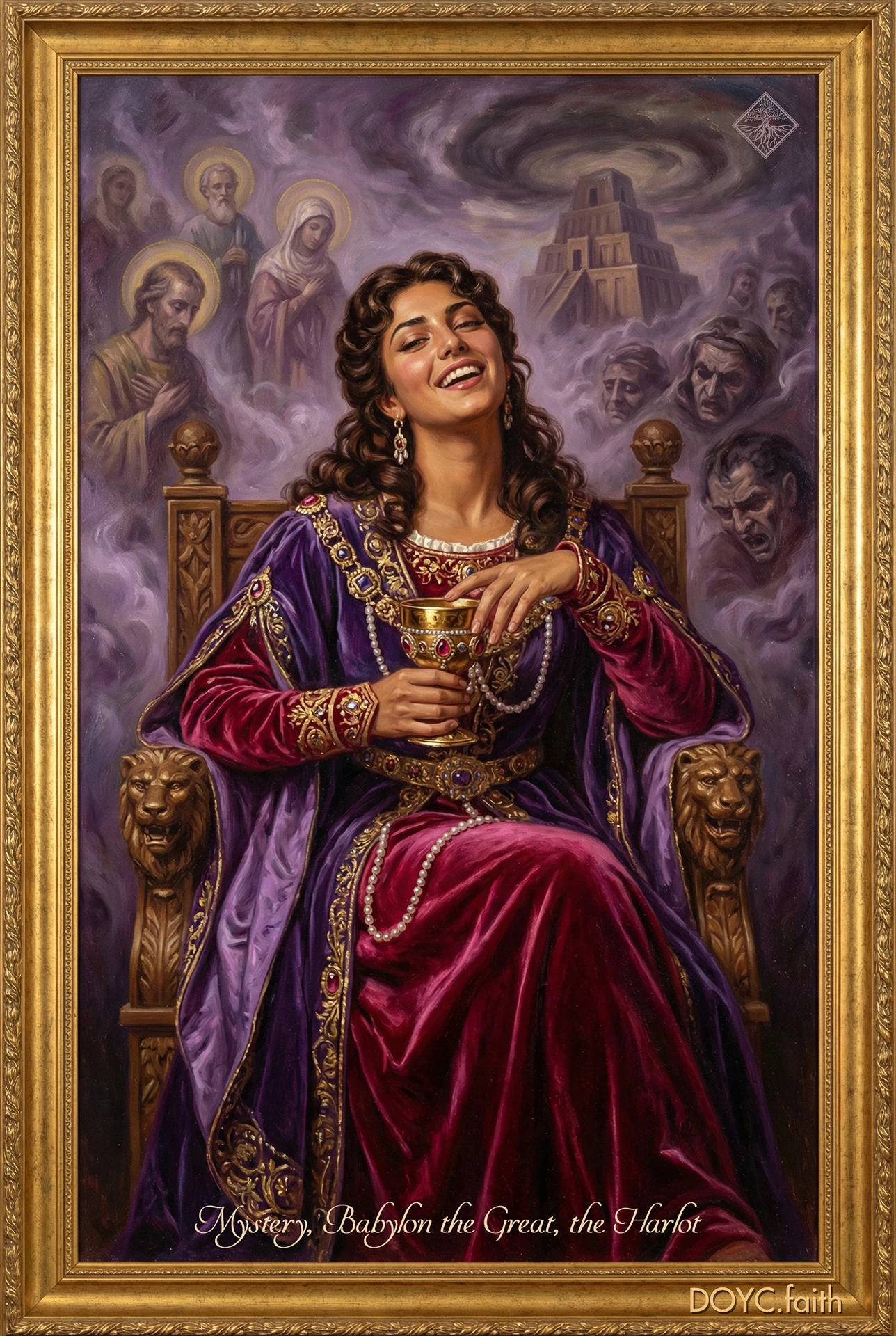
Mystery, Babylon the Great

A. ORIGINS
  • Etymology:
    • Akkadian: Bāb-ilim, meaning “The gate of the gods”.
    • Hebrew: Babel, meaning “Confusion.” This refers not only to the confusion of tongues that took place there, but to the spiritual confusion that has been the hallmark of the secular worldview ever since.
    • The Tower of Babel: Represented a human attempt to concentrate power (in opposition to God’s instructions to spread out) and to “contact the gods” artificially, leading Yahweh to confuse their language and disperse them.
  • Nimrod’s Kingdom: Nimrod, a “mighty hunter” in opposition to God, founded Babel in the land of Shinar (southern Mesopotamia/modern Iraq).
    • Genesis 10 says that Nimrod “became a gibbor,” meaning “mighty one” or “giant.” The Hebrew verb translated as became connotes change as a result of corruption or twisting.
    • Nimrod represents the military and political arm of the Beast+Harlot pairing.
    • Assur either took the mantle of Nimrod, or Assur is the proper name of Nimrod (which could be a title meaning “let us rebel”). Assur went north from Shinar and founded Assyria (Gen. 10:10-12).
      • We may have a clue in Micah 5:6, which seems to use the phrases “Land of Asshur” and “Land of Nimrod” synonymously.
B. SYMBOLISM IN REVELATION 17-18

The mysterious woman is the idolatrous “harlot” system that persists from ancient Babel to the end of the Age. At Babel, humanity turned away from the Creator and embraced idol worship and the worship of the luminaries above.

  • A Global System: She is described as sitting on “many waters” (multitudes/nations) and committing spiritual prostitution with the kings of the earth.
    • False gods and their associated mythologies have been important societal drivers in every world empire (with some exceptions in modern times)
      • The kings of major empires almost always received divine authority to rule through the favor of their pagan priesthoods
  • A Singular City: Despite being a global system, she is explicitly called “a city” in Rev. 17:18; therefore, 
  • Occult and Economic Power: Babel is said to have deceived the whole earth with her sorcery (Rev. 18:23, “pharmakeia”—This can imply both arcane arts and drugs); she is also described as the mercantile hub of the entire world, and the one who grants luxury to kings (18:9).
  • Clothing: Dressed in purple and scarlet (colors of royalty and blood) and vainly adorned with gold and gems. Upper-tier Roman Catholic leaders utilize a very similar look.
  • The Golden Cup: Unlike the humble wooden cup of Christ, her cup is ornate and filled with “uncleanness” and the “blood of the saints.” She consumes filth and disrespects what is sacred.
  • Religious Roots: The harlot on the Beast harkens back to Inanna/Ishtar, the Sumerian/Babylonian goddess of love, war, and fertility. She was frequently portrayed riding or standing on the backs of lions, the most fearsome beasts in the region of Babel.
 
C. THE RELIGIOUS AND ECONOMIC SYSTEMS OF ISHTAR

The system attributed to the goddess Inanna (Ishtar) integrated spiritual authority with fiscal control to dominate the growing population of Mesopotamia in early history.

  • Occult Foundation: The religion was built upon the rediscovery of “occult powers” and “mystery” knowledge that survived the Flood.
  • Temple Prostitution: Inanna’s priesthood established a religious system centered on the worship of false gods and idols linked with sexual immorality and general licentiousness (a fantastic, if evil, tactic for gaining followers).
  • Ritualized Immorality: This system utilized temple prostitutes as a core component of its religious practice, a concept that originated specifically from Ishtar’s “shtick.”
  • Economic Integration: The religion did not exist in a vacuum; it developed in tandem with a fiscal system designed to maintain economic control over people, particularly within large urban centers.
    • The cult of Inanna at Uruk (a powerful city in Sumeria) thrived financially on account of usury. This same system is at play throughout the economies of the world today.
  • Centralization of Power: This combined religious and economic framework allowed the priesthood to wield great occult and fiscal power, which was then used to grow and sustain ancient empires.
  • Historical Migration: This “package” moved from Mesopotamia to Egypt (where it was honed) and then to Greece and Rome, where it continues to influence modern democratic and commercial structures.
 
D. THE LOCATION OF END-TIMES BABYLON
  • Distinct from Rome: While Rome (the Beast) and Babylon (the Harlot) are partners in the end times, they inhabit separate locations.
  • Geographic Specificity: Babylon is not a metaphor for New York, the Vatican, or Jerusalem. It could certainly be argued, however, that such cities are daughters of Babylon.
    • Jerusalem is compared to Sodom and Egypt in Revelation 11:8. It is not compared to Babylon.
      • Many prophecies foretell the restoration of Jerusalem, which will become the capital of the world because the Messiah will reign from Zion. People from every nation will make an annual pilgrimage to her, and they will bring gifts to the King. This is the complete opposite destiny to Babylon, which prophecy promises us will be destroyed so badly that she will never again be inhabited. Babylon will remain a wilderness, and people won’t even get close to her—they will go out of their way to go around Shinar because it will be so desolate and perhaps toxic.
    • Mystery Babylon sits on a beast that has seven heads, and those heads represent both mountains and kings. This is not the same as saying that the city of Babylon sits on seven hills. It is the beast that is “composed” of seven mountains, not the harlot. Thus, Rome, “the city on seven hills,” cannot be automatically identified as Babylon (which isn’t to say that the Vatican won’t have a major presence in Babylon, or relocate there entirely after WW3).
  • Return to Shinar: Multiple prophecies point to a literal resurgence of the city in the “land of the Chaldeans” or Shinar.
    • Isaiah 13:19, 48:20; Jeremiah 50-51; Zechariah 5:5-11
    • Isaiah 13:20 establishes the Arabs as neighbors of Babylon after its destruction, which means that Babylon must be situated next to the Arabian Peninsula (which Shinar is).
    • This eliminates the possibility that New York City is Babylon… but NYC may be a foreshadow of Babylon.
    • Revelation describes Babylon as a hub for maritime merchants; therefore, it must be a coastal city. This may be fulfilled by rising sea levels returning the Persian Gulf to its ancient boundaries near Ur, or the new city of Babel may be built slightly further south than the old version.

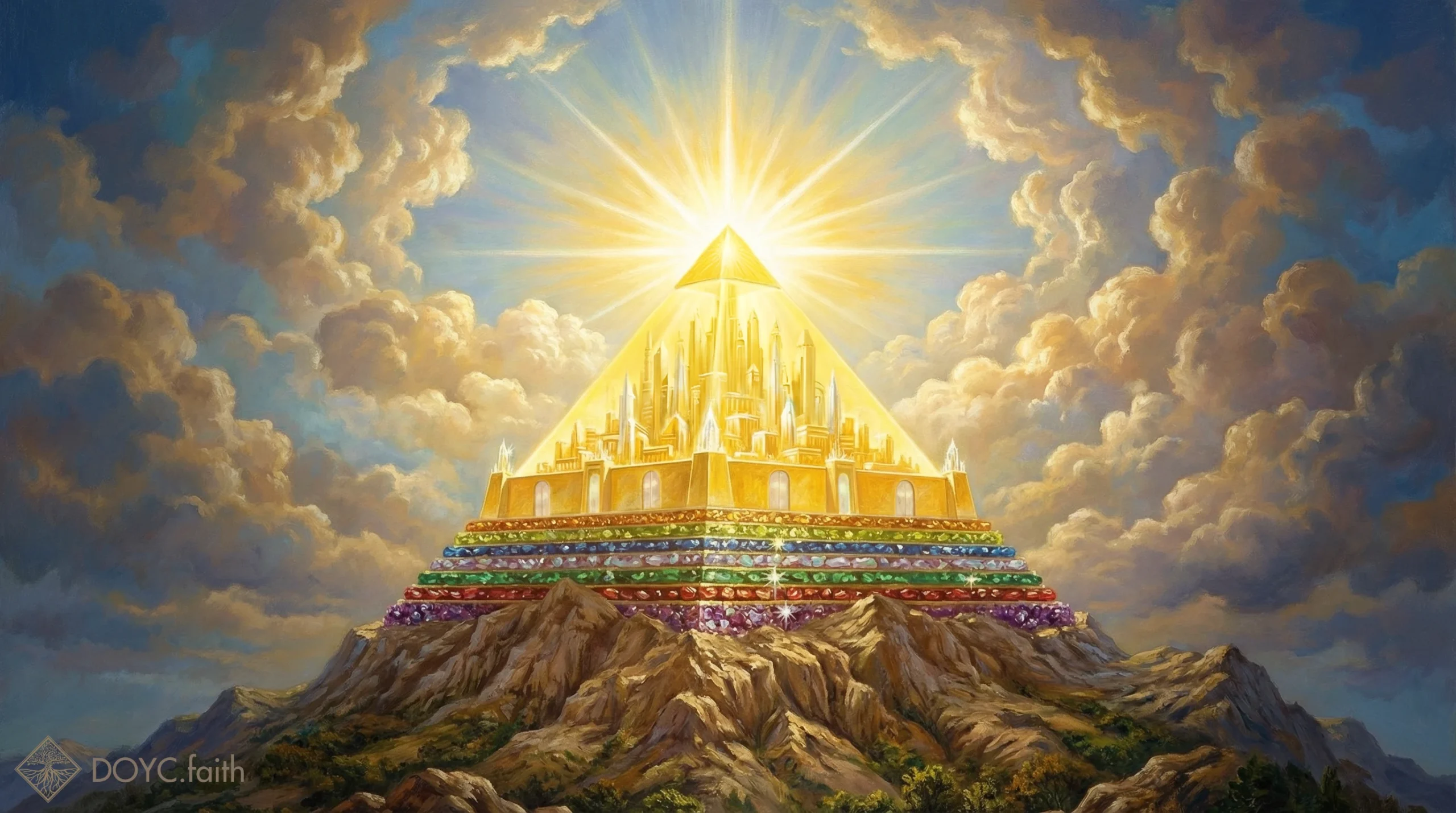
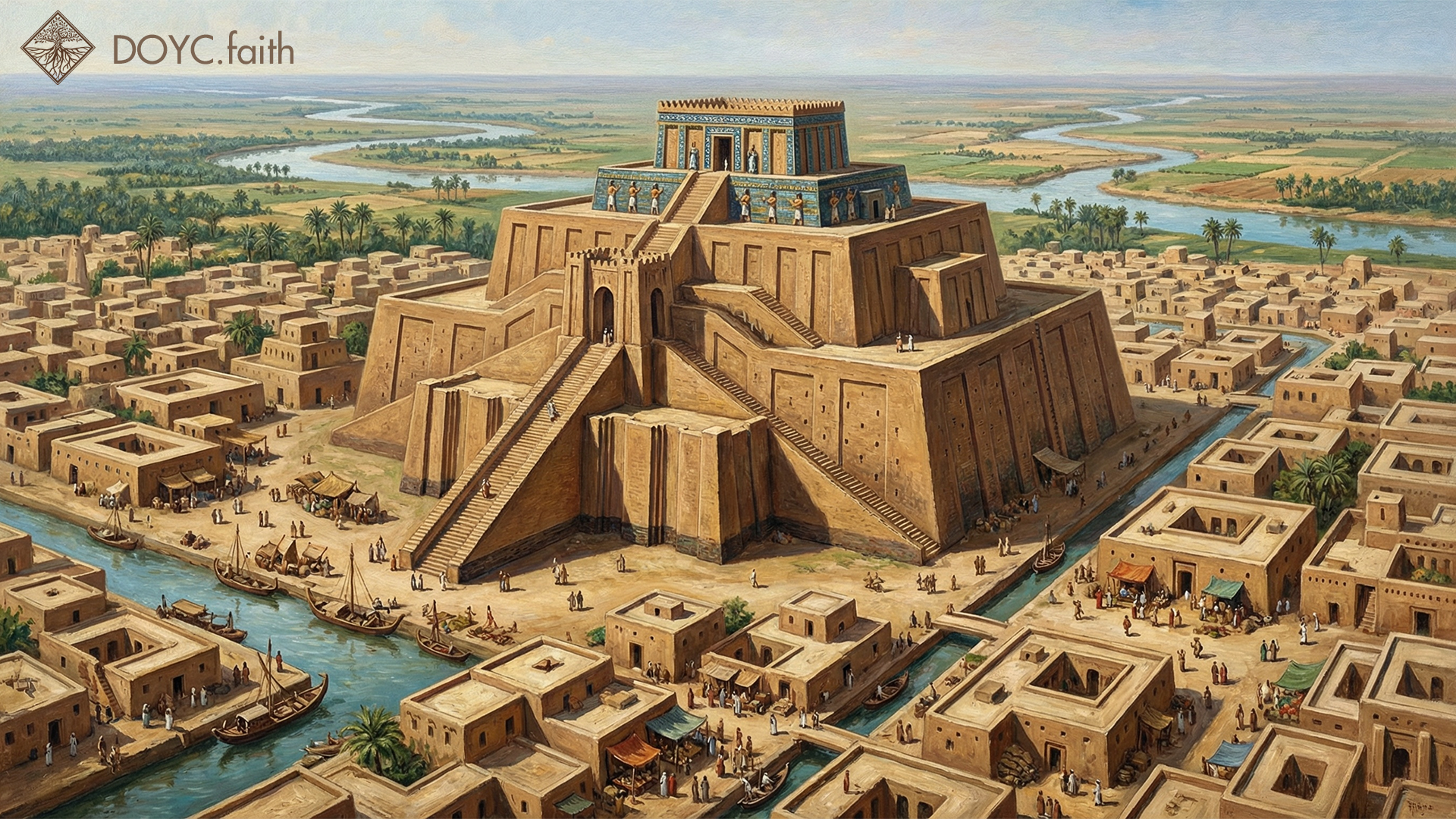
A Tale of Two Cities: Zion vs. Babel

Prophecy presents a juxtaposition between the True King and the Impostor King, it also contrasts God’s city and the Enemy’s city.
Session Seven Intro

This session began with a recap of previous material before continuing with a breakdown of Mystery Babylon and the Beast that she rides. In Revelation 17:7-18, the angel speaking to John provides a specific interpretation for the beast carrying the woman. He says that understanding this will require wisdom, so we should first petition the Lord for wisdom before carefully inspecting the various elements of the angel’s commentary.
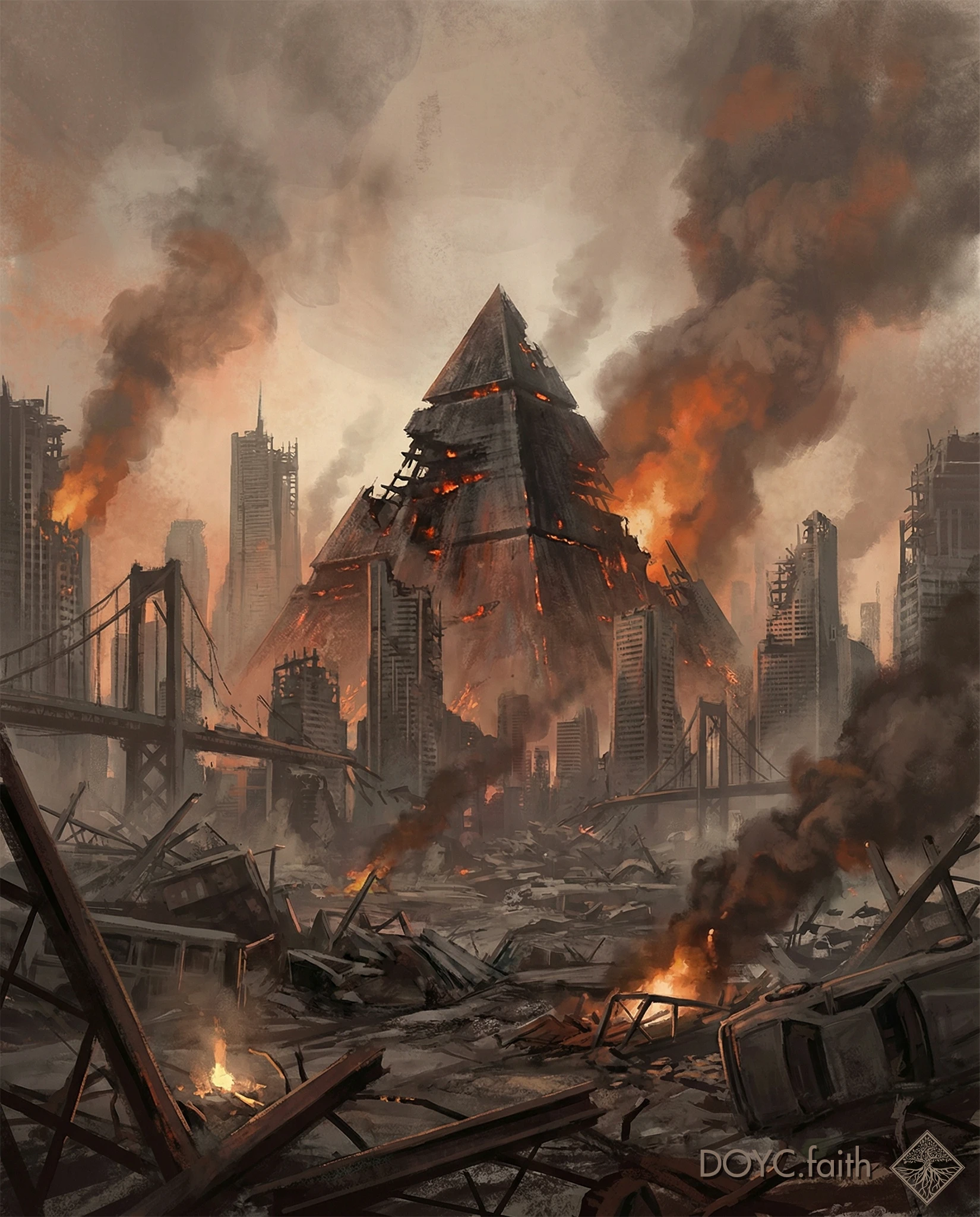
The Angelic Interpretation

A. THE BEAST WITH SEVEN HEADS AND TEN HORNS
  • The Seven Heads: Represent both “seven mountains” (likely signifying spiritual hills/ziggurats) and “seven kings”.
    • Five are fallen: Rulers from the past (Antichrist figures throughout history).
    • One is: A ruler alive during the time of John’s vision.
    • The Seventh: Comes for a short time.
    • The Eighth: An “eighth king” who is actually “of the seven” (implying the return of an ancient ruler).
      • The angel says, “The beast that you saw was, and is not, and is about to rise from the Abyss and go to destruction.” What is this king doing in the Abyss???
        • This corresponds to a passage earlier in Revelation that says, “…the beast that comes up out of the Abyss will make war with them, and overcome them, and kill them.”
        • Remember that the word Abyss is different from the word sea (in both Greek and Hebrew). The Abyss is a bottomless pit or great chasm within She’ol/Hades, the Underworld. It is a real location that acts as a prison for certain evil spirits. It also separates the compartments of righteous dead souls from the compartments of unrighteous dead souls.
      • The angel also says that the spiritually lost masses “will marvel to see the beast, because it was and is not and is to come.” Their amazement is directly linked to the fact that this king has returned.
        • We find a similar statement in Revelation 13:3, which says, “One of its heads seemed to have a mortal wound, but its mortal wound was healed, and the whole earth marveled as they followed the beast.” In other words, one of the seven kings was slain, but he will somehow cheat death before the end of the Age.
        • Considering that the beast “was, and is not” [alive at the time when the oracle was spoken], we must logically deduce that the king with the mortal wound was a king who lived during history prior to John the Revelator.
    • But Also Mountains: The angel says that the heads are not just king, but also mountains. Each great empire that has followed the paradigm of Babel has built ziggurats or pyramids with temples at the top (or, in some cases, religious capstones)—even civilizations in the Americas did this.
      • These are meant to mirror the heavenly mount of assembly, which has the Holy Temple at its peak. Israel also put the Tabernacle/Temple of Yahweh on top of a mountain, and the Lord chose that place for His house.
      • This is a deep, culture-agnostic spiritual pattern.
  • The Ten Horns: Ten future kings of Rome/Kittim who will give their power and authority to the Beast for “one hour” to make war against the Lamb.

Babylon's Sudden Destruction

  • Betrayal by the Beast: The very kings and beast she rides eventually turn on her. They “hate the harlot,” strip her, eat her flesh, and burn her with fire.
  • Sudden Annihilation: While the system flourished for millennia, her final destruction occurs “in one hour”.
  • Historical “Rhymes”: The prophecy mentions the Medes (modern northern Iran/Central Asia) as the actors who destroy Babel, mirroring the ancient fall of Babylon to the Medo-Persians.
  • Final Desolation: The city becomes a haunt for “unclean spirits” and “demons,” never to be inhabited by humans again.
    • Inevitable Judgment: Though the wicked prosper for a time, the Lord appoints a time to pay them what they deserve. What the prophet Enoch said holds true:

Session Eight Intro

This session covers the oracle of Isaiah chapters 13 and 14, which foretell the destruction of Babylon and the fate of her king.

Context is Key

Isaiah wrote this oracle many decades before the Neo-Babylonians invaded Judah, destroyed Jerusalem, and took the Jews captive. Many theologians have therefore read the oracle as being fulfilled in 586 BC. However, the context of chapter 13 should clue us in to the fact that it is about events set to unfold at the end of the Age. The events 586 BC were merely a prevenient fulfillment (i.e., a foreshadow).

ELEMENTS THAT IMPLY A FUTURE FULFILLMENT

When attempting to understand the time setting of this oracle, consider the following:

  • 13:3-4 indicates that many nations are gathering together on the mountains for war—not against Judah, but against the consecrated mighty ones of Yahweh (i.e., the angelic army of the Lord).
  • 13:5-8 expresses the anguish and terror of humanity (“every human heart will melt”) when they see that the Day of the Lord is near. This parallels the oracles of prophets who wrote after the Neo-Babylonian invasion (e.g., 1 Thes. 5:2-3; Rev. 6:15-17; Zech. 14:13)
  • 13:9-10 reveal that the Day of the Lord will coincide with dramatic cosmic disturbances the likes of which the world has never seen. Parallel prophecies include Ezek. 32:7-8; Joel 2:10, 31; 3:15; Zeph. 1:15-16; Matt. 24:29; Rev. 6:12-14.
  • According to vv. 11-13, almost no human beings will be left alive after God levels His wrath upon the world. This in no way relates to the events of 586 BC.
  • Verses 19-22 declare that Babylon will be destroyed as thoroughly as Sodom and Gomorrah, and will never again be inhabited. Only wild beasts, sirens, monsters, and devils will dwell there. This has not yet come to pass.
  • Chapter 14 begins by promising the descendants of Israel that they will turn the tables and enslave the people of Babylon who had enslaved them. This did not historically occur after the Babylonian Exile of the 6th century BC.


Given these considerations, we have no choice but to treat Isaiah 13 & 14 as unfulfilled prophecy.

The Taunt Song Against Lucifer

Isaiah 14 provides a “dirge” or taunt song (v. 4) against the end-times king of Babylon, highlighting his extreme hubris.

A. THE MISUNDERSTOOD NAME
  • Lucifer: This name comes from the Latin translation of the Hebrew Helel ben Shachar, meaning “Shining One, Son of the Dawn”. It is the only use of this term in all Scripture. This has mistakenly been applied to Satan.
    • Satan no doubt empowers the king of Babylon, but the name that has been translated in the KJV Bible as Lucifer is given to the earthly king who is the target of this taunt—not to the spirit called Satan.
    • Shachar means “dawn” or “morning twilight” in Hebrew, but there’s more to it than that in the wider cultural context of the ancient Near East.
      • A Northwestern Semitic language was shared back and forth between the Hebrew, Ugaritic, Pheonician, Moabite, Amorite, Edomite, and Punic peoples. Because of that, not all Hebrew words were of Hebrew origin.
      • Shachar in Canaanite Ugaritic texts was a specific deity: the god of the dawn. His name became the word for dawn in Hebrew.
      • Athtar was a major deity in Canaanite mythology, whose named means “brilliant one” or “shining one,” synonymous with Helel. He is often identified as the son of Shachar (the dawn) and associated with the planet Venus as the morning star. Venus in its morning phase heralds the coming of the sun.
        • In the Ugaritic Ba’al Cycle (KTU 1.6), Athtar attempts to take the throne of Ba’al on Mount Zaphon (the mountain of the Canaanite pantheon)  but is too small or unsuitable to fill it and eventually descends to rule the earth instead.
        • Yeshua is twice called “the morning star” in Scripture (Rev. 22:16; 2 Peter 1:19), for he shines in the darkness to herald the coming of the full light. We can deduce from this that Athtar, the Canaanite version of the morning star, is a false version of Messiah. In other words: he is Antichrist. Thus, the King of Babylon is the Antichrist, the false light-bringer.
  • Context: The passage is explicitly addressed to the King of Babylon, not a spirit alone. This is most certainly a human being because:
    • This man is sent to the receptacle of lost souls, not to the Abyss; whereas Satan will be locked in the Abyss (Rev. 20:1-3).
      • Torment and the Abyss are both part of She’ol, but are nonetheless separate locations within She’ol.
    • He is specifically called “a man” (Hebrew: eesh) in v. 16.
    • He is compared to other earthly kings who were entombed after death.
    • He is said to have children who could build cities if left alive.


Since Lucifer, when correctly understood, is actually a title for the Antichrist, King of Babylon, we ought to stop using that as a name for Satan.

B. THE FIVE “I WILLS” OF HUBRIS

The King of Babylon attempts to storm the spirit realm through five specific declarations:

  1. I will ascend to heaven.
  2. I will raise my throne above the stars of Yahweh.
  3. I will sit on the Mount of Assembly (Mount Zaphan/”The North”).
  4. I will ascend above the heights of the clouds.
  5. I will make myself like the Most High.

Recall what Daniel foretold about the “little horn” (i.e., the 11th horn), that it “waxed great even to the host of heaven; and it cast down some of the host and of the stars to the ground, and stamped upon them. Yea, he magnified himself even to the prince of the host…” (Dan. 8:10-11).

Frightening! This man will somehow be so powerful that he will pull down stars! He will plan to enter the spirit realm and take control of the cosmos. This goal harkens back to the original Tower of Babel, whose top was going to be “in the heavens” (Gen. 11:4). Concerning this, Yahweh said, “Behold, they are one people, and they have all one language, and this is only the beginning of what they will do. And nothing that they propose to do will now be impossible for them” (Gen. 11:6).

As incredible as it sounds, we must admit that the end-time King of Babylon will have the means—likely through arcane arts—to resume Babel’s initial mission and threaten the very heavens. Of course, as in the myth of Athtar, he will not succeed, which is the comforting promise of Isaiah’s prophetic taunt.
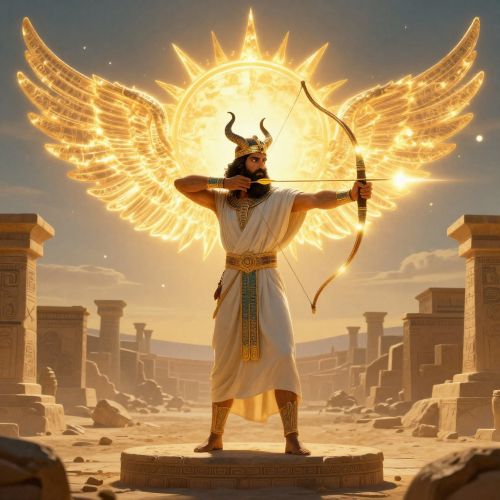
C. THE CONNECTION TO ASSUR

If we keep reading immediately beyond the taunt, we find that Yahweh swears to destroy “the Assyrian” in the Promised Land, and thereby rescue Israel from the enemy’s yoke. This is a thematic continuation of the beginning of the chapter, which foretells the reversal of Israel’s captivity. We should wonder, then: what is the connection between the King of Babylon and The Assyrian?

  • The original Hebrew text lacks the definitive (“the”) at the beginning of v. 25. Young’s Literal Translation faithfully renders it as “to break Asshur in My land.”
  • The word Asshur (alternatively spelled Assur) is the name of the second son of Shem (Gen. 10:22). As the progenitor of the Assyrians, that nation is called by his name. In Hebrew, there is no word for Assyrian; it is simply Assur.
    • Context must be used to determine whether a text is mentioning the nation of Assyria or the man, Assur.
  • Recall that Assur went forth from Shinar/Babel to found the Assyrian empire (Gen. 10:11); or, if translated differently, Nimrod expanded his kingdom into the territory of Assur. Either way, the Babylonian system was planted in Assyria.

After declaring His future victory over Assur, Yahweh then explains that “this is the purpose that is purposed concerning the whole earth, and this is the hand that is stretched out over all the nations” (Isa. 14:26). This implies that Assur (or the Assyrians) will have scattered the Israelites across the world and put them under subjection in many nations, which, in turn, implies that Assur will have dominion over much of the earth. He must have that dominion in order to force the world to choose either the blasphemous Mark of the Beast or stand fast in the covenant of the Blood of Yeshua.

That being said, we have already established that Kittim/Rome, not Assyria, is the terrible beast that will dominate the world at the end of the Age. Rome is not the same as Assyria, although Rome did spread to control the same territory as Assyria. Nonetheless, the names are not synonymous.

Given that fact, we should operate under the theory that Assur in Isaiah 14:25 refers to the man, not the nation.

The next session provides more understanding of this man from a variety of scriptures.

Session Nine Intro

The Antichrist is more than a simple, charismatic political figure or social revolutionary; he is an ancient entity whose return will shock the world.

The Beast Throughout Revelation

A. THE BEAST FROM THE SEA VS. THE ABYSS

The Beast first appears in Rev. 11:7, seemingly without any introduction, and is called “the beast that comes up out of the Abyss.” He bursts onto the scene after the Two Witnesses of God have been prophesying for 3.5 ‘times’ (roughly equivalent to years), makes war with them, and kills them.

However, it’s important to note that the Abyss is opened in Revelation ch. 9, and a king called Apollyon (“Destroyer”) emerges from it. Depending on whether or not you treat Revelation as chronological, this event may occur before the Two Witnesses. Could Apollyon be another term from the Beast?

It isn’t until chapter 17 that we again see an association between the Beast and the Abyss. An angel tells John, “The beast that you saw was [living], and is not [now living]; and is about to come up out of the Abyss and to go into destruction.” 

  • This appears to be ironic wordplay if linked to 9:11—the Destroyer who comes up from the Abyss will himself be cast down into destruction.

Curiously, Revelation ch. 13 presents us with a slightly different picture. It says that the Beast comes up out of the sea rather than the Abyss.

  • Beast from the Sea: Represents the end-times empire (Kittim/Revived Rome) and its combined geopolitical power as wielded by 10 kings.
  • Beast from the Abyss: Represents a specific man who rises from the supernatural underworld to become the final and ultimate king of Rome.
    • A Part of She’ol: The Abyss, also called “the bottomless pit” or just “the pit” is a supernatural chasm in the Underworld (She’ol). It is the place where fallen Watchers and their offspring, the human/angel giant hybrids (gibborim), are currently locked up. It seems to be the central feature of She’ol, and it separates the receptacles of dead souls; Torment and Paradise are situated on opposite sides of this chasm. Perhaps all the compartments of She’ol are accessed through this shaft.

Strangely, Revelation presents the Beast from the Sea and the Beast from the Abyss as one and the same. The link is made obvious primarily by the identical descriptions in 13:3 and 17:8. In biblical prophecy, kingdoms and their kings are often treated synonymously.

 
B. THE FATAL WOUND

Revelation 13:3 describes one of the heads of the Beast as being slain by a sword and then healed. It is popular within Dispensationalism to teach that the Antichrist will receive a fatal head wound during his rise to power. That interpretation falls apart when we pay attention to the verbiage. By saying “one of his [seven] heads,” John is expressing that one of the seven historical kings of the Beast kingdom was killed in a way that left obvious and grievous wounds. The whole earth will be stunned that the king is brought back after receiving such damage—from weapons and from the passage of time.  (Remember not to get the seven heads mixed up with the ten horns; it has both head-kings and horn-kings).

  • Dark Mirror of Christ: This is a “dark resurrection” intended to deceive the earth into thinking this man is divinely favored.
  • Technological/Occult Means: This return might be accomplished through a combination of rediscovered “genetic material” (cloning) and ancient “arcane arts”.
 
C. A COVENANT WITH DEATH & SHE’OL

It is not uncommon among scholars to suggest that Isaiah 28:14–22 describes the same covenant as we read about Daniel 9:27 (where the Antichrist makes an agreement with many nations, seemingly on behalf of Israel). If so, it corroborates the idea that the Antichrist will rise from the dead, because Isaiah says that the covenant is made with death and hell.

We have made a covenant with death, and with hell [Hebrew: She’ol] are we at agreement; when the overflowing scourge shall pass through, it shall not come unto us…. Therefore thus saith the Lord God, ‘Behold, I lay in Zion for a foundation a stone, a tried stone, a precious corner stone, a sure foundation: he that believeth shall not make haste. Judgment also will I lay to the line…. And your covenant with death shall be disannulled, and your agreement with hell [Hebrew: She’ol] shall not stand; when the overflowing scourge shall pass through, then ye shall be trodden down by it’…. Now therefore be ye not mockers, lest your bands be made strong: for I have heard from the Lord God of hosts a consumption, even determined upon the whole earth.” (Isaiah 28:14-22)

Whatever this “overflowing scourge” is, the entire earth will be subjected to it. The people of Judah will believe themselves protected from it because of their deal with someone who holds dominion over both death and the realm of the dead.
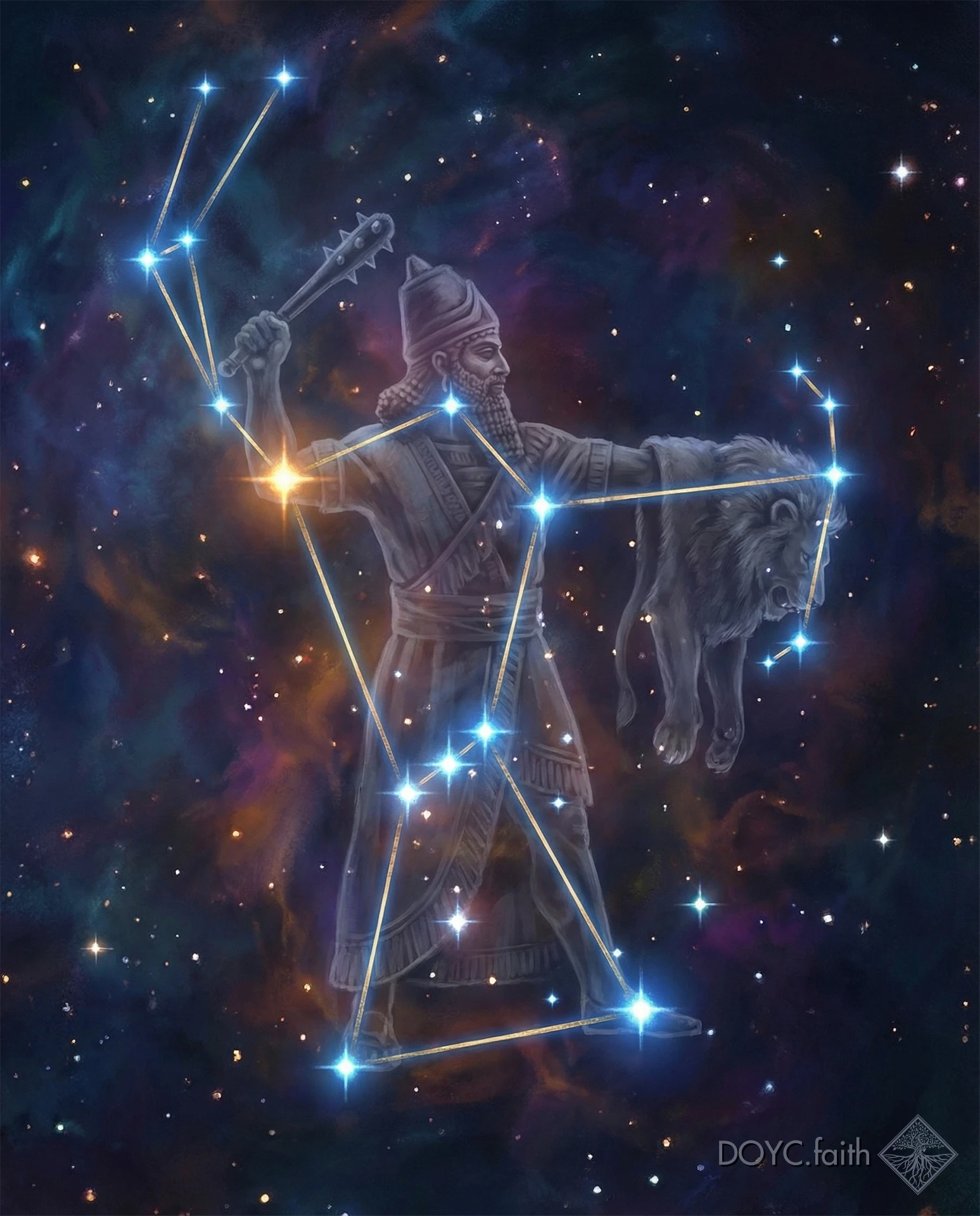
The Once and Future (Impostor) King

Historical researchers have long equated the Egyptian Osiris with the Assyrian Assur and the Babylonian Asar (Marduk), suggesting they all stem from a single original source in the Near East.

A. POINTS OF COMPARISON
  • The Marduk-Osiris Link: In Babylonian records, the title for the god Marduk was Asar or Asarri (oddly similar to Assur), written with symbols for a “seat” and an “eye”—the same symbols used in the earliest forms of Osiris’s name. Furthermore, all three entities are classified as “water gods,” “vegetation gods,” “underworld gods,” and “resurrection gods”.
  • The Osiris-Assur Link: Babylonian Asar was referred to as “the good being,” which matches the Egyptian title for Osiris, wn nfr (Un-nefer), which also translates to “the good being”.
    • Historian Sidney Smith suggests that a common origin for both the Osiris myth and the Marduk-Assur myth can be located in Syria.
    • The ancient Egyptian name for Osiris, written as wsjr, is pronounced in a way very similar to the name Assur, and its root means “powerful” or “mighty,” echoing Gen. 10:8.
    • Isis is the sister and wife of Osiris. The Greeks and other ancient writers recognized the cross-cultural connection between Isis and the eastern goddess Ishtar, thus indirectly linking Osiris to Mesopotamia.
      • Sargon the Great, who ruled over the first Akkadian empire, built magnificent temples for his two favorite deities: Zababa (Nimrod/Assur) and the warrior goddess Ishtar.
      • During the Festival of Khoiak in Egypt, women impersonating Isis would wander the temple grounds, mourning and reciting “Lamentations” to find the body of slain Osiris. This echoes the annual mourning of Ishtar for her brother-husband, who was exiled to the Underworld. Thus, we have a ritual connection between Isis and Ishtar.
  • Mesopotamian Origins of Osiris: Diodorus Siculus recorded that the Egyptians (sons of Mitsraiym, the brother of Cush), were actually colonists sent out by “Ethiopians” (the Land of Cush) and led by Osiris. This aligns with the biblical genealogy where Cush begat Nimrod.
    • W. M. Flinders Petrie and David Rohl identified a group called the “Falcon Tribe” who migrated from Sumer to Egypt around 3100 BC. They brought Mesopotamian pottery, cylinder seals, and architecture to Egypt.
 
B. THE MYTHOLOGY OF OSIRIS
  • The “Mighty Hunter”: Just as Nimrod is described in Genesis as the “Mighty Hunter squaring up to the Lord,” the Egyptians identified the demigod Osiris with the constellation Orion, the Mighty Hunter in the sky. (They called Orion “the Hidden One,” and also “The Glorious Soul of Osiris.”)
  • Death by the Sword: The Antichrist is described in Revelation as having a “wound by a sword,” and Osiris is described in the Pyramid Texts as having been “slain by the sword” or “laid low” by a violent act.
  • The Seventy-Two Conspirators: Plutarch records that 72 conspirators aided in the murder of Osiris. Seventy-two is an important number, biblically. Yeshua sent out 72 disciples to spread the kingdom. Why did he pick that number? Perhaps because it’s the total of all divine rulers engaged in cosmic conflict: 70 angels who were given authority over the nations following the fall of Babel, plus Satan’s Seed, plus God’s Seed, equals 72.
  • Birthing the Heir: In myth, Isis was impregnated by the corpse of Osiris to produce Horus, who took the throne of his father. This “Order of Horus” is viewed by secret societies as the preservation of the secret knowledge of Nimrod (i.e., the “mysteries” of Babel, which originated before the Flood).
 
C. RESURRECTION HOPES
  • The First Mummy: Isis (the Egyptian Ishtar/Mystery Babylon) created mummification specifically to preserve Osiris’s remains—including his “efflux” (bodily fluids)—so he could return in the future. Every future mummification procedure copied this one.
    • Coffin Texts Spells 1080 and 1087 specify that the efflux of Osiris is protected in Rostau, the network of tunnels beneath the Giza Plateau (in fact, Rostau is another name for Osiris, so the Giza underworld is named after him).
  • Egyptian Texts: Sacred inscriptions dating back to roughly 2300 BC contain “resurrection” spells that describe Osiris being physically raised.
    • Utterance 576 explicitly states that the king (identified as Osiris) “will not rot” and “will not putrefy”.
    • Various utterances command the god to “raise yourself,” “awake,” and “throw off the earth which is on you.”
    • One text from the Book of the Dead records Osiris declaring, “I have the power to be born a second time!”
    • Ancient Egyptian stories, such as the Story of Setna, explicitly mention a future time when Osiris would return.
      • In the narrative, the spirit of a prince asks to have his family’s mummies reunited so they may “await together the Day of Awakening, when Osiris returns to the world”.
  • The “Passion Plays” and Rituals: The annual Festival of Khoiak involved a five-day reenactment of the death and rebirth of Osiris.
    • The festival culminated on the fifth day with the demigod being “reborn at dawn” and the ritual of the “Raising of the Djed-pillar,” which likely signifies the backbone of Osiris.
    • Unlike other “dying and rising” gods of the ancient world, the Egyptians viewed Osiris as a “dead” god in the underworld who would one day make a definitive physical return.

Scriptural Witnesses of Assur's End

We’ve seen, thanks to Isaiah 14, how She’ol will receive the King of Babel; now we will look at prophecies that foretell the Antichrist’s death at the return of the real Christ.

  • Isaiah 30-31: Assur is broken by the “voice of Yahweh” (cf. 2 Thess. 2:8) and falls by a supernatural sword, eventually fleeing before being captured and judged.
  • Isaiah 10: God uses Assur as a “rod” to punish apostate Israel, but eventually punishes Assur for his own haughtiness and boasting.
  • Ezekiel 31: A powerful analogy of Assur as a “Cedar of Lebanon” whose height (pride) reached the thick foliage. He is ultimately cast down to She’ol with those who go to the “pit”.
  • 2 Baruch 36:5-11; 39:8-40:2: The mighty “cedar tree” will be brought before the Messiah, judged, and cast into fire (cf. Daniel 7:10-11 & Revelation 19:20). His hosts will be put to the sword. 
  • DSS, War Scroll Col. 1:6: On the Day of the Lord, Assur will have no one to help him. Assur will fall and the supremacy of the Kittim will cease.
  • Nahum 3:19: Everyone will rejoice upon hearing that Assur has fallen.
  • Micah 5: Predicts the Lord will raise up “seven shepherds and eight leaders” to deliver Israel when the Assyrian enters the land.

Modern Application:
The Giza Discovery

It’s long been understood that many tunnels occupy the space beneath the Giza plateau, but we may just be discovering the scope of this underground world. Scans have recently verified massive columns and chambers beneath the Giza pyramids, matching ancient claims of a subterranean complex called Rostau.

Who did this? Who could have pulled off such a feat of engineering within the enormous limestone bedrock of Giza?

A. A UNIFIED BUILDING PROJECT

Astounding megalithic structures, scattered across the world, continue to defy conventional explanations. Despite their diverse placement, the structures share many similarities in their construction. In most cases, we do not understand the techniques that were used, even though we are supposedly more advanced than previous civilizations.

Many cultures around the world—from South America, to Africa, to Europe, tell stories that attribute megalithic structures to non‑local, “advanced” beings. For instance, in the Andes, some Indigenous oral traditions describe bearded foreigners arriving in a mysterious way in the distant past and teaching advanced stonework, or even building sites such as Tiwanaku, Puma Punku, and Cusco.

To make sense of the existence of these stories and the associated megalithic mysteries, we must understand that they were only made possible because of the Mysteries that came out of Babel (and, before that, from the fallen Watchers). The earliest post-Babel civilization was not primitive. In fact, due to the heavenly secrets that they possessed, they were in some ways more advanced than we are today.

More and more researchers are concluding that these structures were all built within a narrow window of history, as if by the same globe-spanning civilization. This conclusion is becoming more unavoidable by the week as ground-penetrating satellite scans reveal evidence of vast road networks and mighty cities buried not far beneath the surface of the earth, or submerged just off the coast.

 
B. ASSUR’S WORLD EMPIRE IN EZEKIEL 31

The theory of an early, global civilization—advanced, yet with a total population in the millions, not billions—matches with the version of history presented in Ezekiel ch. 31, which teaches that Assur ruled an incomparable world empire that oversaw “all great nations” (v.6). When Assur was brought down to She’ol, all the nations quaked, and the rulers of nations fainted (vv. 15-16).

  • The narrative of ch. 31 is that the “cedars of Eden” became envious of Assur’s might and reach because they “could not rival it,” so they accused him before God of being immeasurably arrogant. The Lord ruled against Assur and had him slain, “in order that none of the trees [representing rulers, as in Dan. 4:9-18] by the waters exalt themselves in their stature.”
    • These trees of Eden (the paradise of God) must represent the 70 Kosmokraters, rebellious members of God’s divine council. They were envious because the 70 nations had been put under their authority, yet all the attention and worship was going to Assur.
    • The trees of Eden “were comforted” when Assur fell (v. 16). However, they have also been assigned She’ol as their dwelling-place (vv. 16-17), so maybe they shouldn’t celebrate too much.
  • The citizens of Assur’s empire went their separate ways after its downfall (v. 12). The nations of men and even spirits [symbolized as “the birds of the heavens” in v. 6] now dwell “on its fallen trunk” (v. 13). This metaphorically tells us that we are all living on top of the ruins of Assur’s civilization.
  • Some Greek historians attributed megalithic construction techniques to the Cyclopes, who were supposedly giants with one eye. Of course, the giants from the line of Canaan weren’t one-eyed, but that mythology may have developed because of the religious motif of Ra, the sun god: The All-Seeing Eye. Sun worship is central in all the religions that came out of Babel, but the iconography of the Eye of God seems to have been popularized by the Egyptians.
    • The Freemasons trace their fraternity back to the Cyclopian builders, whom they claim were founded and taught by Nimrod. If true, it means the Cyclopian building techniques were derived from occult knowledge.
  • In Ezekiel 31:2-3, Pharaoh and his power is compared to Assur. This is likely because the priests of Egypt magically imbued the spirit of Osiris/Assur into each Pharaoh at his coronation.


The Great Pyramids of Giza (and the subterranean complex beneath them) are the most famous and astounding feat of megalithic construction in the world. We should therefore pay close attention to the fact that the sizes and positions of the three pyramids mirror the three bright stars of Orion’s belt, one of the most easily recognizable groups of stars in the night sky. The Nile river that runs alongside the pyramids is meant to mirror the Milky Way above, which runs alongside the constellation Orion. This heaven-and-earth alignment scheme conforms to the occult mantra, “As above, so below.”

  • The sheer magnitude of the Giza pyramids building project is unmatched even today. In fact, now that we know approximately how much was carved out of the bedrock below the pyramids, the magnitude is almost inconceivable. What better burial site could you find for the ancient king of the world?
 
C. THE PROPHETIC WARNING (MATTHEW 24:23-28)
  • “The Inner Rooms”: Yeshua warned not to believe those who say the Messiah is in “the desert”—potentially the desert of Giza—or is in the “inner rooms”—potentially referring to the hidden chambers beneath the pyramids.
  • The Eagles and the Corpse: Matthew 24:28 states, “Wherever the corpse is, there the eagles (Kittim/Romans) shall be gathered”. The sermon interprets this as the “revived Roman” powers gathering to recover the corpse and “efflux” of the ancient king (Osiris/Assur).
  • The Real Deal: When the actual Messiah, Yeshua, returns, it will be in the sky, and it will illuminate the heavens like lightning. Don’t believe in or listen to any Messiah that doesn’t come down, riding on the clouds, with the host of heaven following him!

Sessions Ten & Eleven Intro

Finally, we return to the Olivet Discourse to make a more thorough survey. This was probably Yeshua’s last sermon, and it was certainly the most eschatalogical in nature.

Parallel accounts of the discourse: Matthew 24:1-51 = Mark 13:1-37 = Luke 21:5-38

The Delivery of a New Age

A. AN OUTLINE OF THE OLIVET DISCOURSE
  • Deceptions + Pre-Messianic Woes

    • The Warning: “See that no one leads you astray.”
    • The Chaos:
      • Political: Wars and rumors of wars; nation rising against nation.
      • Natural: Famines and earthquakes in various places (Matt/Mark); “terrible sights” in the heavens (Luke).
    • The Perspective: These are not “The End,” but the beginning of birth pangs. Do not be terrified.
  • The Persecution: Witness in the Fire

    • The Cost: You will be delivered to synagogues, prisons, and before governors (Luke).
    • The Promise: Do not rehearse your defense. The Holy Spirit will give you a “mouth and wisdom” that none can contradict (Luke).
    • The Division:

      Betrayal by parents, brothers, and friends. But “by your endurance, you will gain your lives.”

  • The Abomination: The Historical/Prophetic Pivot

    • The Sign: The “Abomination of Desolation” standing where it ought not (Mark). Luke clarifies this for a Gentile audience: “When you see Jerusalem surrounded by armies.”
    • The Urgency: If you are on the housetop, don’t go down. If you are in the field, don’t go back. Flee to the mountains.
    • The Great Tribulation: A time of distress unequaled since the beginning of the world. For the sake of the elect, those days will be shortened.
  • The Parousia: The Coming of the Son of Man

    • The Cosmic Shift: The sun darkened, the moon failing, stars falling. The very powers of the heavens are shaken.
    • The Appearance: The Sign of the Son of Man [note that title] appears. He comes on the clouds with great power and glory (Daniel 7 imagery).
    • The Gathering: A great trumpet blast. The angels gather the “elect” from the four winds, from one end of heaven to the other.
  • The Application: The Fig Tree and the Watchman

    • The Lesson: When the fig tree puts forth leaves, you know summer is near. When you see these things, know He is at the gates.
    • The Certainty: “Heaven and earth will pass away, but my words will not pass away.” This world is temporary, but the things of God are eternal.
    • The Command: No one knows the day or hour. Therefore: Stay awake. Be like servants waiting for their master. Don’t let your heart be weighed down with dissipation or the cares of this life (Luke).


The Lord’s opening remark was a warning not to let ourselves be led astray, deceived. That has to be our ongoing highest priority. Seek and hold fast to the truth. In the armor of God, the belt of truth holds the outfit together. Without the truth, you’re going to lose all your protection.

B. The Birth Pains / Contractions

The progression of end-time events is described by Yeshua as “birth pains” (v. 24:8). As with the delivery of a baby, the pains grow closer together and more intense over time. These events align closely with the Seal Judgments of Revelation 6.

  • First Seal / False Christs: Rising deception by those claiming messianic authority.
  • Second Seal / Global Conflict: “Wars and rumors of wars”—an unusual scale of conflict that serves as a precursor, but not yet “the end”.
  • Third Seal / Scarcity: Widespread famine and economic distress.
  • Fourth Seal / Death by Combined Threats: Here we have a slight divergence. Yeshua did talk about famine and war, but he did not mention pestilence or wild beasts. Instead, he foretold earthquakes in diverse regions.

According to 2 Baruch 27, the birth pains of the end times are divided into 12 distinct aspects ranging from “commotions” and “death” to “attacks of the shediym (demons)” and “fire.”

  • The Sign of Completion: The Messiah is revealed only after all 12 parts are accomplished across the whole earth.
  • Non-sequential: The parts mix and mingle with one another; they are not chronological, which adds to the confusion and uncertainty about what is actually happening. Non-believers will not understand that they are experiencing
  • Duration: God tells Baruch that “the measure and reckoning of that time are two parts a week of seven weeks.” In Hebrew, that last phrase is “a seven of seven sevens.” This is referring to a Jubilee cycle: 7 x 7 years, or 7 Shemitah cycles, for a total of 49 years. “Two parts” of 7 Shemitah cycles equals 2 Shemitah cycles, which is equivalent to 14 years. In other words, the birth pains, once truly begun, will last fourteen years.

Key takeaway: We are currently witnessing only the prelude or the very beginning of the contractions. The “consummation of the times” requires a crescendo to a global climax.
A lightning strike to the globe
C. DEFINING “THE END”

“The end” is the closure of the 6th millennium and the commencement of the Messianic Age (the 7th millennium). The scriptures call this “the Day of the Lord,” or sometimes simply “that Day.”

  • The Harvest: Yeshua defines the end as a harvest where angels (reapers) separate law-breakers from the righteous (Matt. 13:39-43). The parable of the harvest finds its fulfillment in Revelation 14:14-20.

  • Guarding the Heart: As lawlessness increases, the “love of many will grow cold.” We are called to hold fast to morality even when the world upends it, but at the same time, we must continue to have compassion for sinners.

  • The “Son of Man” Title: Yeshua utilized this title to signal His identity as the Cosmic Judge.

    • In the Book of Enoch (written pre-Flood, and understood as the first scripture), the Son of Man is portrayed as:

      • Pre-existent: Named before the Lord of Spirits even before the stars were created.

      • Overthrower of Tyrants: One who overturns kings from their thrones for failing to acknowledge the source of their power.

      • Staff of the Righteous: A staff for the faithful and the “Light of the Nations”.

      • He Comes in Judgment: Anyone familiar with Enoch would have understood the implications when Yeshua said during the Olivet Discourse, “Then will appear in heaven the sign of the Son of Man, and then all the tribes of the earth will mourn, and they will see the Son of Man coming on the clouds of heaven with power and great glory.”

D. THE GENERATION OF THE FIG TREE

A contextual challenge to Premillennialism is found in Mark 13:30/Matthew 24:34 (“This generation will not pass away…”).

  • Linguistic Context: The Greek genea may mask deeper Semitic meanings. In Hebrew (dor) or Aramaic (sharbtha), the phrase can refer to a race of people or a specific era of rebellion. Yeshua wasn’t necessarily referring to the particular generation of people listening to him speak.

  • The Fig Tree Symbol: Likely represents Judah or specifically the Levites.

    • As we see the Levites revive the Temple and the practices of the earthly priesthood, and we witness many Jewish people embracing the way of Torah again, we can be sure that the leaves of the proverbial tree are becoming tender, and the time is near.

    • When Yeshua said “this generation shall not pass away until all is completed,” he was likely referring to the generation that would witness the fig leaves become tender.

  • The Promise: Despite the “Great Tribulation” following the Abomination of Desolation, Yeshua promises that Israel as a people will be preserved until His return. There is comfort in knowing that the end of the Age won’t spell out the end of the Hebrew people.

The Fall Mo'ediym as End-Times Prophecies

Eschatology is effectively the “Holy Calendar” written in the future tense. The seven festivals in Leviticus 23 are God’s divine appointments, His master plan for redemption.

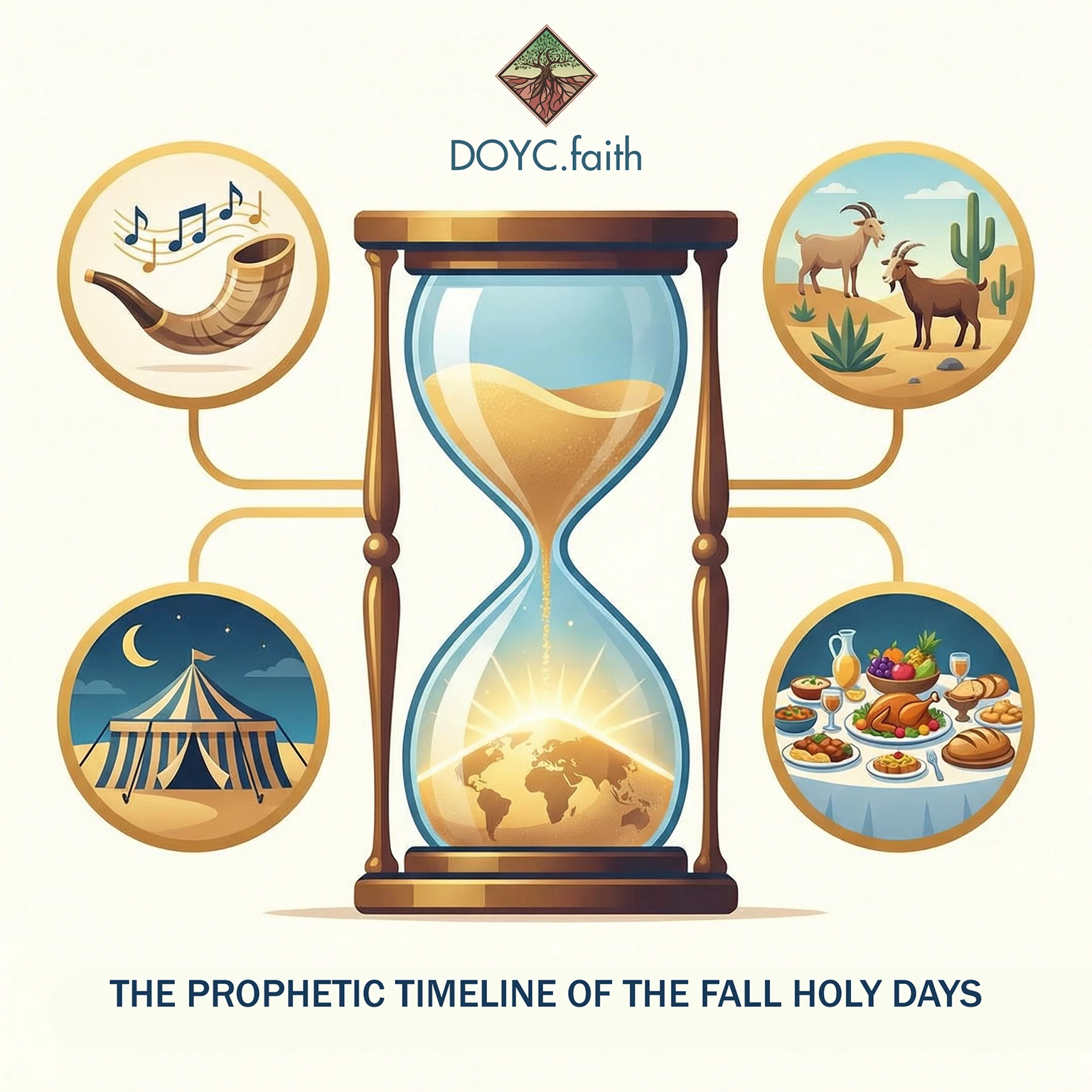
The 7 appointed times of YHVH aligned with the menorah's lamps
  • Spring Mo’ediym: Yeshua perfectly fulfilled the first four feasts to the day and hour at His first coming.
    • Pesach (Passover): His death as the blemishless Lamb.
    • Chag HaMatzot (Unleavened Bread): The disciples fully come out of a system of false doctrines.
    • Bikkurim (Firstfruits of Barley): Yeshua’s resurrection and the resurrection of some dead saints along with him (Matt. 27:53). They ascend and present themselves as a wave offering in the heavenly Temple.
    • Shavuot/Pentecost (Firstfruits of Wheat): The pouring out of the Ruach HaKodesh (Holy Spirit), the initial harvest of “wheat” (souls) into Yeshua’s storehouse, and the reversal of Babel’s division of tongues and nations.
  • Fall Mo’ediym: As-yet-unfulfilled prophetic “rehearsals” for the Second Coming. This becomes our interpretive key. If the Spring Feasts were fulfilled literally, the Fall Feasts must be fulfilled literally at His second coming. This model is inherently premillennial, as it places the “long summer” (the current age) between Shavuot and the next feast.
    • Yom Teruah (the Alarm): The “Day of the Awakening Blast.” This is the “shout” (1 Thess. 4:16), the alarm of the King’s arrival. This is the “sign of the Son of Man” (Matt. 24:30) that appears to the whole world, initiating the final, climactic “Days of Awe” and triggering the world’s terror and Israel’s final moment of teshuvah (repentance).
    • Yom Kippur (The Gathering & Atonements): This day has a dual nature. For faithful Christians, this will be the day of our deliverance from this world as Yeshua comes down for his people. For the Jews who haven’t acknowledged their king, it will be the day of their return and salvation.
      • Yom Kippur every 50 years incorporates the Shofar Gadol (the Great Trumpet), the Jubilee trumpet of ultimate release and liberty. It is literally “the last trump” of the cycle of mo’ediym (1. Cor. 15:52).
        • The Harpazo: At this trumpet sound, the resurrection and gathering occur. The redeemed are “released” from mortality to “return” to their inheritance (the Kingdom).
      • National Atonement (Zech. 12:10): This is the day when “all Israel” looks upon “him whom they have pierced” and recieve forgiveness (Rom. 11:26).
      • This day will also kick off the wrath of God against the wicked, which will be poured out over a period of 40 days.
    • Sukkot (The Wedding Week): This is the consummation of the times, when Yeshua and his bride move from betrothal to marriage in the heavens. Meanwhile, the bowls of wrath are doing their work on the Beast kingdom on earth.
      • This honeymoon week of isolation with Yeshua is what Isaiah cryptically foretold when he wrote:
        Come, my people, enter your chambers, and shut your doors behind you; hide yourselves for a little while until the fury has passed by. For behold, YHVH is coming out from His place to punish the inhabitants of the earth for their iniquity, and the earth will disclose the blood shed on it, and will no more cover its slain. (Isaiah 26:20-21)
    • Shemini Atzeret (The Wedding Feast): This is a celebration of starting a new, unending life together. Immediately after the bride and groom emerge from the wedding booth, a great feast ensues, representing entrance into the joyful paradise of eternal fellowship.
THE PROPHETIC TIMETABLES

The numbers in Daniel and Revelation are not arbitrary; they are liturgical intervals:

  • 1,260 Days: This timespan is listed in Rev. 11:2-3, 12:6, and 13:5. In a 360-day biblical year, 1260 days equals exactly 3.5 years.
    • The calendar given by Enoch stipulates a 364-day calendar, but the four days which start the seasons are “not counted,” thereby leaving 360 official days per year.
      • Nowhere else in Scripture are we provided with the definition of the 360-day year utilized by prophecies in Revelation and Daniel.
    • This calendar quirk is the reason why the prophetic books speak of annual cycles as “times” instead of “years.” They are nearly but not quite the same.
  • Interval Specifics: A 1,260-day count beginning on Passover (14th of Nisan) lands precisely at the start of Sukkot (Tabernacles) in the third year.
  • 1,290/1,335 Days: The 1,290 and 1,335 days in Daniel 12 are prophetic time periods, starting from the “abomination that causes desolation” (Antichrist setting up an idol in the Temple), with the 1,290 days marking the end of this period and the 1,335 days adding 45 extra days of blessing for those who endure to the very end before Messiah’s return.
    • These represent the exact distances required to move between Spring and Fall festivals when using a 360-day calendar.